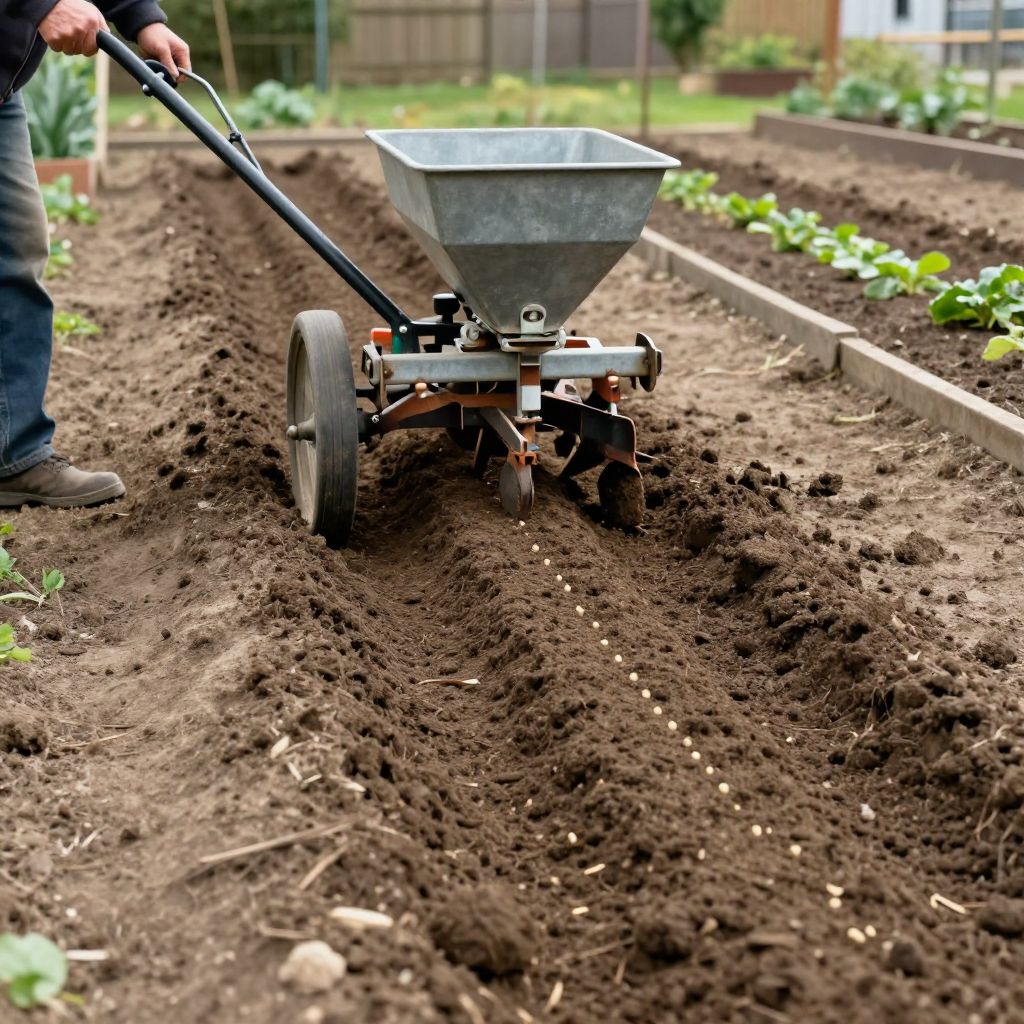
What is a seed drill, and why do gardeners and farmers use one? If you’ve seen neat, evenly spaced rows of seedlings and wondered how they were planted so precisely, a seed drill is often the tool behind that result.
In simple terms, a seed drill places seeds at a controlled depth and spacing in prepared soil. That helps improve germination, reduces waste, and makes later thinning easier, whether you’re sowing a small vegetable patch or managing a larger garden bed.
What is a seed drill?
A seed drill is a planting tool or machine that opens a shallow furrow, drops seeds at a set rate and depth, and then covers them with soil. It creates more even rows than hand broadcasting, which helps seeds germinate uniformly and gives young plants a better start.
How a seed drill works
Most seed drills follow the same basic process: a cutting edge or opener makes a narrow trench, a metering system releases seed, and a covering mechanism closes the soil over the seed. In larger versions, a press wheel firms the soil lightly for good seed-to-soil contact.
Main parts you may see
- Seed hopper or container: holds the seed.
- Metering system: controls how much seed is released.
- Furrow opener: makes the planting line.
- Covering device: moves soil back over the seed.
- Press wheel or roller: firms the soil lightly after sowing.
What is a seed drill used for in gardening?
Gardeners use seed drills to sow vegetables, herbs, flowers, and cover crops in straight, evenly spaced rows. The tool is especially useful for small seeds that need consistent depth, such as carrots, lettuce, radish, spinach, and many annual flowers.
Why row sowing matters
- Seeds are planted more evenly than by hand scattering.
- Rows make weeding, watering, and thinning easier.
- Plants often emerge more uniformly.
- You can better estimate how much seed you need.
Types of seed drills gardeners may encounter
Seed drills range from simple hand tools to larger tractor-mounted machines. The right type depends on the size of your garden, the crop, and how precise you want the spacing to be.
Hand seed drills
These are small tools for home gardeners. Some are push-style row planters, while others are hand-cranked devices that dispense seed into a furrow.
Push seeders
Push seeders are common in market gardens and larger home plots. They roll along the bed, open the soil, drop seed, and cover it in one pass.
Mechanical and tractor-mounted drills
These are used on larger areas. They can plant many rows at once and are designed for more consistent spacing and depth across bigger fields or extensive vegetable gardens.
How to use a seed drill correctly
Using a seed drill well starts with good soil preparation. The bed should be loose, level, and free of stones, clods, and debris so the opener can create an even furrow and the seed can make proper contact with the soil.
- Prepare the bed by raking it smooth and removing large clumps.
- Check seed size and choose the correct drill setting if your tool has interchangeable plates or metering options.
- Set the depth according to the crop’s needs; many small seeds need only shallow coverage.
- Fill the hopper with dry seed so it flows evenly.
- Test the drill on a short section first to confirm spacing and depth.
- Walk or drive steadily to keep the row even.
- Inspect the row after sowing and lightly water if the soil is dry.
Important planting rule
Do not bury seeds too deeply. A common mistake is assuming deeper planting means better protection. In reality, many seeds struggle to emerge if they are covered too heavily, especially in heavy soil.
Best soil conditions for seed drilling
Seed drills work best in soil that is moist, crumbly, and not sticky. If the soil is too wet, it can smear and compact; if it is too dry, the furrow may not close well and seeds may not get enough moisture to sprout.
- Good drainage helps prevent seed rot and crusting.
- Fine tilth improves seed-to-soil contact.
- Moderate moisture supports germination without waterlogging.
- Organic matter such as compost can improve soil structure over time.
If your soil is heavy clay, wait until it is workable rather than forcing a drill through wet ground. In sandy soil, pay extra attention to moisture retention because seeds can dry out quickly after sowing.
Seed depth, spacing, and crop choice
The right settings depend on the crop. Small seeds usually need shallow planting, while larger seeds can be placed deeper. Always check the seed packet or crop guidance and adjust the drill accordingly.
General guidance for common garden crops
- Very small seeds such as lettuce or celery: often sown very shallowly.
- Medium seeds such as beetroot or spinach: usually sown a little deeper than tiny seeds.
- Larger seeds such as beans or peas: can be planted deeper, but still within the crop’s recommended range.
Spacing matters too. Crowded rows can lead to weak growth, poor airflow, and more disease pressure. If your drill drops seed too thickly, thin seedlings early so the strongest plants have room to develop.
Advantages of using a seed drill
A seed drill is more than a convenience tool. It can improve the quality of your planting and reduce the amount of follow-up work needed after sowing.
- More even germination.
- Less seed waste.
- Better row alignment for cultivation and watering.
- Less hand thinning in many crops.
- Faster planting over larger beds.
For gardeners growing in straight rows, this can make maintenance simpler throughout the season, especially when using a hoe, drip irrigation, or row covers.
Common problems when using a seed drill
Even a good seed drill can give poor results if the soil, seed, or settings are wrong. Most issues are easy to troubleshoot once you know what to look for.
Seeds are not dropping evenly
This may happen if the seed hopper is damp, the seed is irregular in size, or the metering setting is wrong. Clean the tool, dry the seed, and test again with a small amount before sowing the whole bed.
Seeds are too deep or too shallow
Adjust the opener or depth setting. If the soil is loose and fluffy, the drill may sink more than expected; if the soil is hard, it may not cut deeply enough.
Rows are crooked
Uneven walking speed, poor bed layout, or rough soil can cause wandering rows. Mark the bed first with a line, string, or shallow guide furrow.
Patchy germination
Patchy emergence can come from uneven watering, old seed, soil crusting, or planting too early into cold soil. Keep the seedbed evenly moist and check the crop’s temperature needs before sowing.
Seed drill vs. broadcasting by hand
Broadcasting means scattering seed across the soil surface. It can work well for some flowers, lawns, or cover crops, but it is less precise than drilling. A seed drill is usually the better choice when you want rows, consistent depth, and easier weed control.
- Use a seed drill for row crops, precision sowing, and efficient spacing.
- Use broadcasting for dense plantings or natural-looking drifts where exact rows are not needed.
Tips for better results with a seed drill
Small adjustments can make a big difference in germination and crop uniformity. Focus on bed preparation, seed quality, and moisture management.
- Use fresh seed when possible, especially for crops with short viability.
- Level the bed before sowing so depth stays consistent.
- Water gently after planting if rain is not expected.
- Protect newly sown rows from birds if your crop is vulnerable.
- Thin seedlings at the right stage rather than waiting too long.
For very fine seeds, some gardeners mix seed with dry sand to help it flow more evenly through simple hand drills. If you do this, keep the mix consistent so you do not over-sow one section and under-sow another.
When a seed drill is most useful
A seed drill is especially helpful in vegetable gardens, raised beds, allotments, and small-scale market gardens where neat rows and efficient use of space matter. It is also useful when you want to sow a cover crop or green manure evenly across a prepared bed.
It may be less useful for wildflower-style plantings, informal cottage borders, or very tiny garden spaces where hand sowing gives you more control.
Conclusion
So, what is a seed drill? It is a tool that sows seed at a controlled depth and spacing, making planting more accurate and often more successful. If you are planning a row crop, prepare a fine seedbed, set the drill carefully, and test it on a short run before sowing the whole area.
For more practical gardening guidance, you may also want to read about seed starting basics and vegetable garden soil preparation.