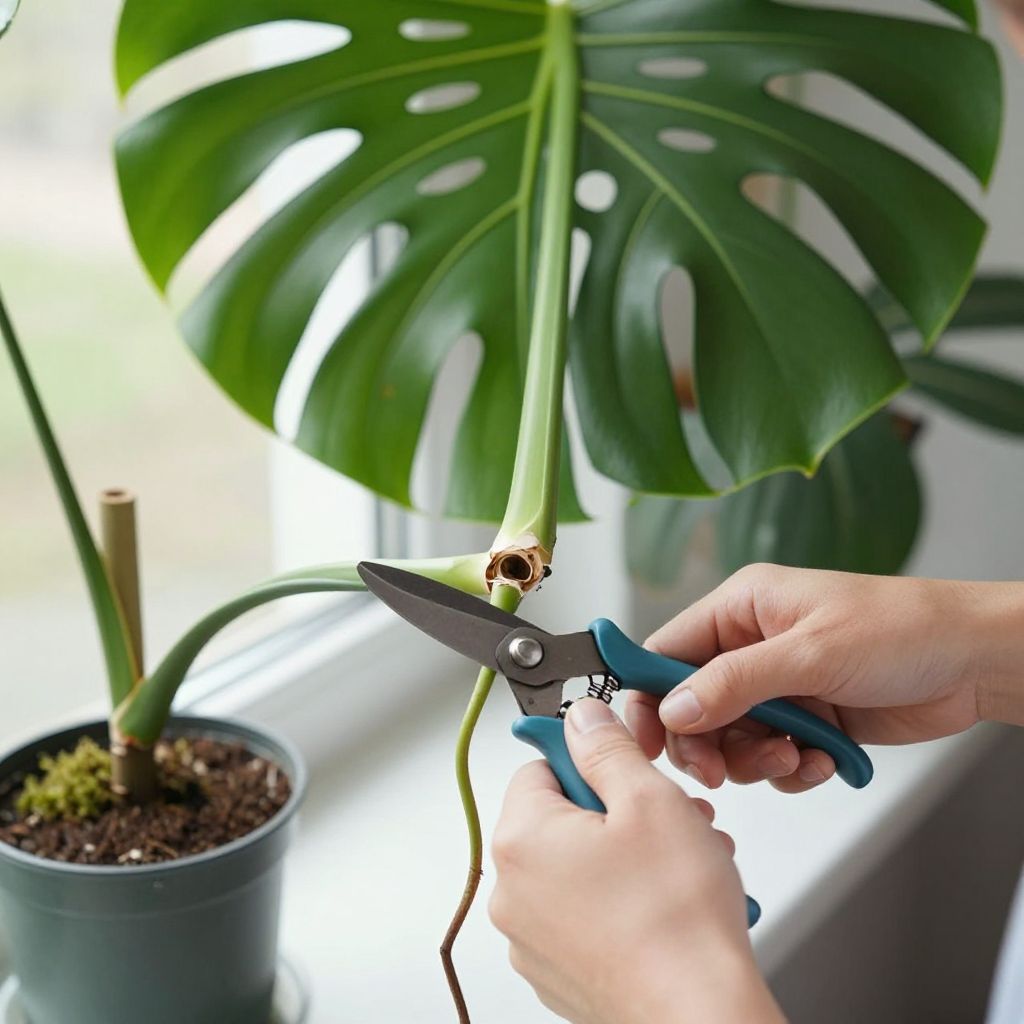
Wondering where to cut Monstera deliciosa without hurting the plant? The right cut depends on whether you want to prune for shape or propagate a new plant. The key is to cut at the stem between nodes, not through a node itself, and to keep at least one healthy node on any cutting you plan to root.
With a few simple rules, you can trim an overgrown monstera, encourage fuller growth, and make successful cuttings. The trick is knowing what part of the stem to remove, how much to take, and how to avoid common mistakes that slow recovery.
Where to cut Monstera deliciosa?
Cut Monstera deliciosa on the main stem just below a node if you want to propagate, or just above a node if you are shortening the parent plant for shape. A node is the knobby point where a leaf, aerial root, or dormant bud emerges. Never remove all nodes from a section you want to regrow.
How to identify the right cutting point
Before you make a cut, look closely at the stem. Monstera deliciosa grows in segments, and each segment usually has a node, a leaf petiole, and often an aerial root.
What to look for
- Node: the thickened joint on the stem where new growth can emerge.
- Internode: the bare stretch of stem between nodes.
- Aerial root: a root that may hang from a node and can help a cutting root faster.
- Leaf petiole: the stalk that holds the leaf blade; do not treat this as the main stem.
If you are unsure, follow the stem from a leaf back to the main vine. The node is usually just behind the leaf attachment and may have a small bump, ring, or root nub.
Best places to cut
- For propagation: cut 1 to 2 cm below a node so the cutting includes the node.
- For pruning the mother plant: cut 1 to 2 cm above a node to leave that node on the plant for new growth.
- For larger top cuttings: keep at least one leaf and one node, though two nodes often root more reliably.
How to prune Monstera deliciosa step by step
Pruning is useful when the plant is leggy, too tall, leaning, or taking up more space than you want. Monstera deliciosa can handle pruning well if you make clean cuts and avoid removing too much at once.
- Choose a healthy stem section with visible nodes.
- Use clean, sharp pruners, scissors, or a knife.
- Decide whether you are shaping the plant or taking a cutting.
- Cut just above a node on the parent plant, or just below a node on the cutting.
- Remove damaged, yellowing, or crowded leaves if needed.
- Wipe sap from tools and surfaces after cutting.
Important: do not cut randomly through the middle of a leaf stalk and expect the plant to branch there. New growth comes from nodes, not from the leaf blade or petiole.
How much can you remove?
For a healthy indoor monstera, it is usually safer to remove only a portion of the plant at one time. If the plant is weak, stressed, or recently repotted, make lighter cuts and wait for recovery before pruning again.
- Take off dead or damaged leaves anytime.
- Reduce long, bare stems gradually if the plant is very overgrown.
- Leave enough foliage for photosynthesis so the plant can recover.
Where to cut if you want to propagate
To propagate Monstera deliciosa, the cutting must include at least one node. A leaf alone will not make a new plant. If possible, include an aerial root as well, because it often improves rooting success.
Best cutting types
- Single-node cutting: one node with a leaf or root; compact but slower and more delicate.
- Two-node cutting: more reliable for beginners and easier to root.
- Top cutting: the growing tip with several leaves and at least one node; often roots well if healthy.
Make the cut with a swift, clean motion. A ragged cut can dry out or invite rot, especially if you are rooting in water or a moist medium.
Water or soil for rooting?
Both can work. Water rooting lets you watch root development, while a well-draining propagation mix can reduce the shock of moving roots later. Choose the method that fits your experience and your indoor conditions.
- Water: change it regularly and keep the node submerged, not the leaf.
- Moist sphagnum or airy mix: keep evenly damp, never soggy.
- Potting up: wait for several roots before moving to a pot with drainage.
How to cut an overgrown monstera for fuller growth
If your monstera has a long bare stem, pruning can help it look fuller. The plant will not usually branch from every cut, but it can push new growth from nodes below the cut if conditions are good.
Encouraging a bushier look
- Cut above a node to stimulate the plant below that point.
- Return multiple rooted cuttings to the same pot for a fuller display.
- Provide brighter indirect light so the plant can produce stronger new leaves.
- Use a moss pole or support to help the plant climb instead of sprawled growth.
For indoor plants, support matters. A monstera that climbs often develops larger leaves and a more natural shape than one left to trail without support.
When is the best time to cut Monstera deliciosa?
The best time is usually when the plant is actively growing and healthy, which is often spring through early autumn indoors, depending on your home conditions. In cooler months or low-light periods, growth slows and cuts may recover more slowly.
That said, you can remove a damaged leaf or a broken stem any time. For larger pruning jobs, wait until the plant is stable, well-lit, and not dealing with stress from repotting, pests, or cold drafts.
Signs your plant is ready
- New leaves are forming regularly.
- The stem is firm and healthy, not soft or blackened.
- Leaves are not severely wilted from underwatering.
- The plant has recovered from recent repotting or transport.
Tools and hygiene for clean cuts
Clean tools matter more than many beginners realize. A sharp blade makes a neat cut that heals faster and reduces the chance of stem damage.
- Use sharp pruners, floral snips, or a sterilized knife.
- Wipe blades with rubbing alcohol before and after use.
- Use gloves if you have sensitive skin, since monstera sap can irritate some people.
If you are cutting more than one plant, disinfect between plants to reduce the spread of pests and disease.
Common mistakes to avoid
Most problems after pruning come from cutting in the wrong place or taking too much off at once. A little planning prevents most of them.
- Cutting through a node: this can ruin both the cutting and the parent plant’s growth point.
- Using a leaf without a node: it may stay green for a while but will not become a new plant.
- Removing too much foliage: the plant needs leaves to recover and grow roots or new shoots.
- Leaving soggy cuttings: excess moisture can cause rot, especially in cool rooms.
- Pruning a stressed plant too hard: wait until the plant is stable if it is already struggling.
Troubleshooting after cutting
After pruning or propagating, keep an eye on the plant for a few weeks. Small changes are normal, but certain symptoms mean you should adjust care.
If the cutting turns soft or black
This usually suggests rot. Remove affected tissue with a clean blade, let the cut surface dry briefly if appropriate for your propagation method, and restart in cleaner water or a fresh medium.
If the parent plant looks stalled
Check light first. Monstera deliciosa prefers bright, indirect light indoors. Too little light often slows recovery more than pruning itself.
If leaves yellow after pruning
One older leaf may yellow naturally, but several yellowing leaves can point to overwatering, poor drainage, or root stress. Make sure the pot drains freely and the mix is airy.
If no new growth appears
Be patient. New growth emerges from nodes and may take time, especially in winter or low light. Keep the plant warm, evenly moist, and well lit without harsh direct sun.
Growing conditions that help the plant recover
Good aftercare helps both pruned plants and cuttings succeed. Monstera deliciosa grows best indoors with bright, filtered light, warm temperatures, and a chunky, well-draining potting mix.
- Light: bright indirect light is ideal.
- Soil: an airy aroid mix with bark, coco coir or peat-based material, and perlite works well.
- Drainage: always use a pot with drainage holes.
- Watering: water when the top layer of mix begins to dry, then let excess drain away.
- Support: a pole or stake helps upright growth.
A healthy root system is the foundation of good regrowth. If the plant is in dense, waterlogged soil, fix that before expecting strong new shoots.
What to do with the cuttings
Once you have a viable cutting, you can root it, share it, or use it to fill out another pot. If you are keeping it, place it in stable conditions and avoid moving it around too much.
- Keep the node in contact with water or moist medium.
- Provide bright, indirect light.
- Maintain warmth and avoid cold windowsills or drafts.
- Pot up only after roots are well formed and ready to support the plant.
When roots are established, transplant into a pot with drainage and an airy mix. Water it in lightly, then let it settle before resuming normal care.
Conclusion
If you remember one rule, make it this: cut Monstera deliciosa at the stem near a node, not through it. Use the node position to decide whether you are pruning the parent plant or making a cutting, and keep your tools clean for the best results. If you want to keep learning, a good next step is reading more about Monstera care and support tips and simple indoor plant propagation methods.