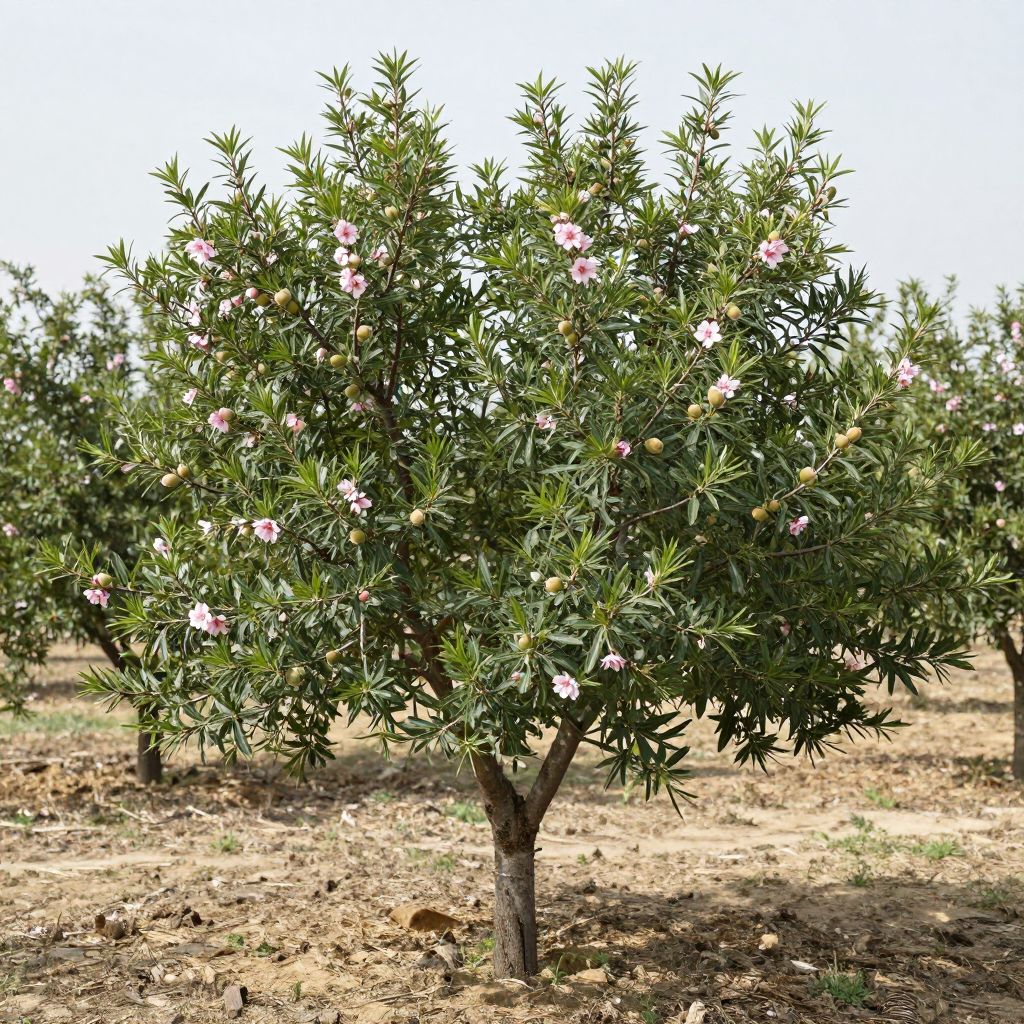
If you’re asking, “What does an almond tree look like?” the answer depends a little on the season. Almond trees are medium-sized deciduous trees with narrow, lance-shaped leaves, smooth gray-brown bark, and showy pale pink to white blossoms in late winter or early spring.
They can look delicate when flowering and more like a classic orchard tree once in leaf. Knowing the bark, leaves, flowers, fruit hulls, and overall growth habit helps you identify them correctly and decide whether one will suit your garden.
What does an almond tree look like?
An almond tree (Prunus dulcis) is a rounded, open-canopy tree that usually grows 15 to 25 feet tall, sometimes larger in ideal conditions. It has gray-brown bark, slender pointed leaves, five-petaled pink or white flowers, and later develops fuzzy green hulls that split to reveal the shell inside.
Key features for almond tree identification
Flowers
Almond blossoms are often the easiest clue. They appear before or just as the leaves emerge, usually in clusters along the branches.
- Color: pale pink to white
- Shape: five-petaled, almond- or cherry-like blossoms
- Season: late winter to early spring in many climates
Because the tree flowers so early, it can be a striking ornamental plant even before it leafs out.
Leaves
Almond leaves are simple, narrow, and pointed, typically 3 to 5 inches long. They are usually bright green, with a smooth to slightly toothed edge.
In summer, the foliage gives the tree a lighter, airier look than many shade trees. The leaves are not broad or dense, so sunlight often filters through the canopy.
Bark and branches
Young bark is smooth and gray, becoming rougher and more furrowed with age. The branches tend to spread outward rather than forming a dense, upright crown.
In winter, the bare branch structure is useful for identification. Almond trees often have a somewhat open, vase-like shape, especially when pruned well.
Fruit and nuts
After flowering, the tree forms green, fuzzy hulls that mature over the season. When ripe, the hulls split open to expose the hard shell containing the almond kernel.
If you see these hulls on the tree, you’re likely looking at a fruiting almond rather than a purely ornamental flowering tree.
How to tell almond trees apart from similar trees
Almond trees are often confused with peaches, apricots, cherries, and ornamental flowering plums because they all belong to the same genus, Prunus. The flowers can look similar, so it helps to check the whole plant, not just the blossoms.
- Compared with peach: peach leaves are usually longer and narrower, and peach fruit is fleshy rather than a dry nut hull.
- Compared with apricot: apricot leaves are broader and more heart-shaped at the base.
- Compared with flowering plum: many ornamental plums have darker foliage or deeper pink blossoms and do not produce edible nuts.
- Compared with cherry: cherry trees often have smoother bark with horizontal markings and different fruit development.
If you are unsure, look at the fruiting stage. Almonds develop a fuzzy hull that dries and splits, which is very different from stone fruit flesh.
Growing conditions almond trees prefer
Almond trees grow best in full sun, warm summers, and well-drained soil. They are not good choices for heavy clay, soggy sites, or places with prolonged spring frost, because flowers can be damaged early in the season.
Sunlight
Give almond trees at least 6 to 8 hours of direct sun daily. More sun usually means better flowering and stronger fruiting.
Soil
Almonds prefer deep, fertile soil that drains quickly. A slightly sandy loam is ideal, but they can adapt if drainage is good.
If your soil stays wet after rain, improve it before planting. Raised beds, berms, or a better-drained site are often more effective than trying to “fix” heavy soil in place.
Watering
Young almond trees need regular watering while they establish roots, but mature trees dislike constantly wet soil. Water deeply, then allow the upper soil to dry somewhat before watering again.
Overwatering is a common mistake. It can weaken roots and increase disease risk, especially in cool or poorly drained gardens.
How to plant an almond tree
Plant in a location with full sun and room for the mature canopy. Because almond trees can become fairly broad, avoid crowding them near fences, buildings, or large shade trees.
- Choose a site with well-drained soil and good air circulation.
- Dig a hole as deep as the root ball and about twice as wide.
- Set the tree so the root flare sits at or slightly above soil level.
- Backfill with native soil unless your soil is extremely poor.
- Water thoroughly to settle the soil.
- Mulch with 2 to 4 inches of organic mulch, keeping it away from the trunk.
Avoid burying the trunk flare or piling mulch against the bark. Both can lead to rot and pest problems.
Pruning and shaping almond trees
Pruning helps maintain structure, improve light penetration, and reduce disease pressure. Almond trees are usually trained to an open center or vase shape in home orchards and many landscapes.
When to prune
Prune during the dormant season in mild, dry weather if possible. In wetter or colder climates, timing may need to shift to reduce stress and disease risk.
What to remove
- Dead, damaged, or crossing branches
- Water sprouts and crowded inward growth
- Low branches that interfere with access or airflow
- Any limbs showing disease cankers or dieback
Use clean, sharp pruners or a pruning saw. Disinfect tools if you cut diseased wood, and remove infected debris from the garden.
Common pests and diseases
Almond trees can face the same pests and diseases as other stone fruits. Good site selection, pruning, and sanitation do a lot of the work for you.
Common pests
- Aphids
- Scale insects
- Mites
- Borers in stressed trees
Watch for curled leaves, sticky honeydew, sooty residue, or small holes in the bark. Healthy trees usually tolerate light pest pressure better than stressed trees.
Common diseases
- Brown rot on blossoms and fruit
- Leaf curl and leaf spots
- Cankers on branches
- Root rot in poorly drained soil
To reduce disease, keep the canopy open, avoid overhead watering late in the day, and clean up fallen fruit and leaves. If a tree repeatedly declines, drainage and site conditions are often the first things to check.
Can you grow an almond tree in a home garden?
Yes, if your climate suits it and you have enough space. Almonds are best in regions with mild winters, dry springs, and hot summers, though local conditions matter more than a map alone.
One important point: many almond varieties need a compatible pollinator nearby to set a good crop. If you want nuts, check whether the tree is self-fertile or whether you need a second tree for cross-pollination.
Best uses in the landscape
- Orchard planting
- Specimen tree for spring bloom
- Edible landscape in sunny, well-drained yards
Because the blossoms are so attractive, almond trees can work as both productive and ornamental plants. Just remember that fruiting success depends on climate, pollination, and spring weather.
Harvesting almonds
Harvest timing varies by variety and climate, but the general sign is when the hulls split and begin to dry. The tree may still hold some green foliage while the nuts mature.
Pick or shake nuts once the hulls open and the kernels are ready. Then dry them thoroughly before storage. If you are growing almonds for the first time, harvest quality can vary a lot from year to year, especially in cooler or wetter seasons.
Common mistakes to avoid
- Planting in heavy, waterlogged soil
- Giving too much shade
- Pruning too heavily or at the wrong time
- Ignoring pollination needs
- Letting fallen fruit and leaves accumulate
These mistakes can reduce flowering, invite disease, and limit nut production. A well-sited tree will usually need less intervention and perform better over time.
Quick identification checklist
- Medium-sized deciduous tree
- Open, rounded or vase-like shape
- Pale pink or white spring flowers
- Narrow, pointed green leaves
- Gray-brown bark that roughens with age
- Fuzzy green hulls that split when mature
If your tree matches most of these traits, there is a good chance you’re looking at an almond tree.
Conclusion
Now that you know what an almond tree looks like, you can identify it by its early blossoms, narrow leaves, open branching, and fuzzy fruit hulls. If you’re considering planting one, start with full sun, excellent drainage, and enough space for mature growth.
For more help identifying trees in your garden, you may also find this tree identification guide useful.