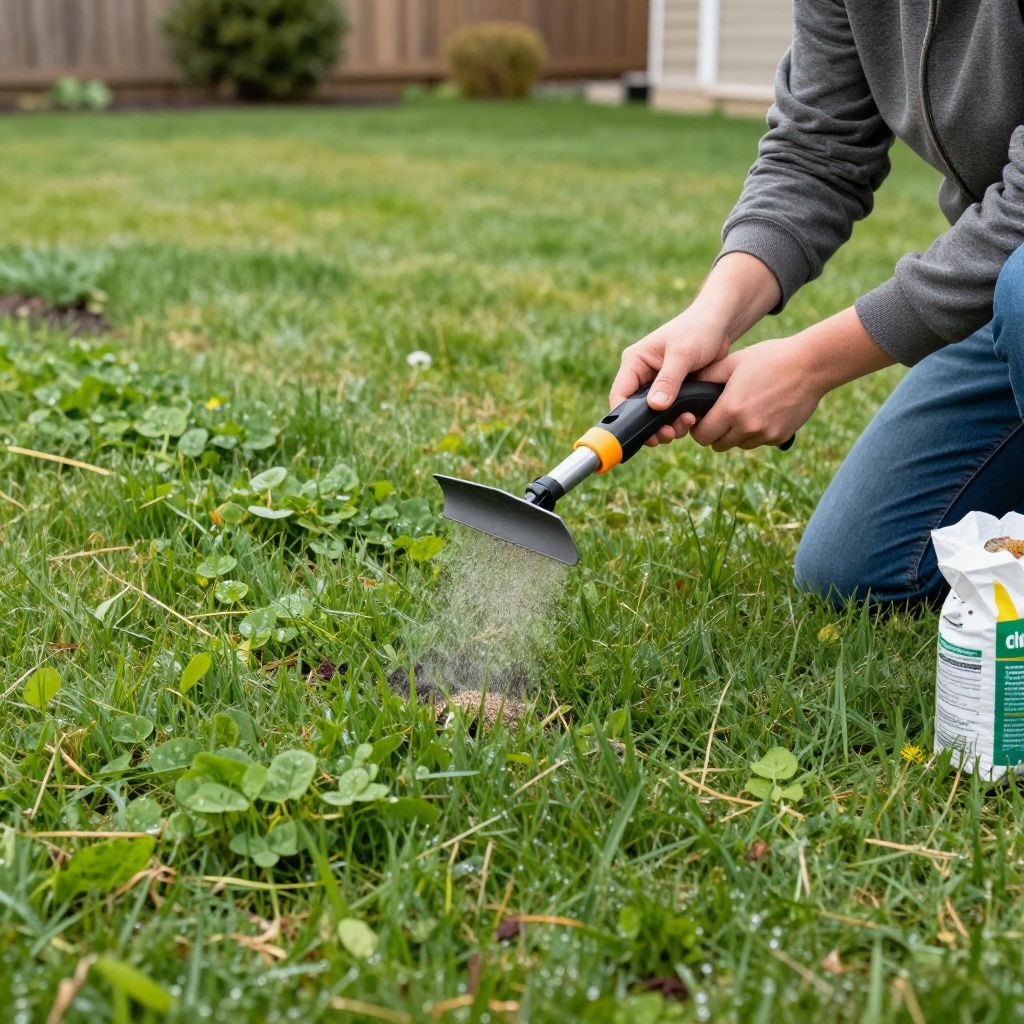
If you’re wondering when to put down weed and feed, timing matters more than most gardeners realize. Apply it at the wrong season, and you may waste product, stress your lawn, or miss the weeds you wanted to control.
The best time depends on your grass type, your local climate, and whether you’re targeting broadleaf weeds or feeding the lawn for growth. In most cases, you’ll get the best results when the lawn is actively growing, weeds are young, and the weather is mild.
When to put down weed and feed?
Put down weed and feed when your lawn is actively growing and the target weeds are small and actively taking up nutrients, usually in mild spring or fall weather. Avoid applying during heat stress, drought, or right before heavy rain. Always follow the product label and match timing to your grass type.
How weed and feed works
Weed and feed products combine two jobs: a fertilizer that boosts grass growth and an herbicide that kills certain weeds, usually broadleaf weeds such as dandelions, clover, and plantain. Because the weed killer is absorbed through the leaves, timing and coverage are important.
It works best when weeds are actively growing and have enough leaf surface to absorb the herbicide. It is less effective on mature, stressed, or dormant weeds, and it will not solve every weed problem in one application.
What it does well
- Controls many common broadleaf weeds in lawns
- Feeds grass during active growth
- Can simplify routine lawn care for small to moderate weed pressure
What it does not do well
- It usually does not control grassy weeds like crabgrass
- It is not a cure for thin turf, compaction, or poor drainage
- It may miss weeds that are too large, stressed, or hidden in dense turf
Best seasonal timing by lawn type
Cool-season grasses
For cool-season lawns such as Kentucky bluegrass, perennial ryegrass, tall fescue, and fine fescue, the best time is usually early fall or spring when temperatures are moderate and the grass is actively growing. Fall is often the better choice because weeds are still active and the lawn can recover quickly.
If you live in a region with hot summers, avoid applying weed and feed during heat waves. Grass under heat stress is more likely to be damaged, and herbicide performance often drops.
Warm-season grasses
For warm-season lawns such as bermudagrass, zoysiagrass, centipedegrass, and St. Augustinegrass, use weed and feed in late spring through early summer after the lawn has fully greened up and is growing strongly. These grasses can be sensitive to some herbicides, so the label matters even more.
Do not apply too early in spring when the lawn is still dormant or only partly green. The grass may not be able to use the fertilizer well, and weed control may be weak.
Transition-zone lawns
If you live where both cool-season and warm-season grasses struggle at different times of year, timing becomes local. Watch your lawn rather than the calendar alone. Apply only when the grass is actively growing, soil moisture is adequate, and daytime temperatures are within the product’s safe range.
How to tell if it’s the right time
A good application window usually has three signs: the lawn is growing, weeds are young and visible, and the weather is calm. If the grass is dormant, drought-stressed, or newly seeded, wait.
- Grass is actively growing: You’re mowing regularly and seeing fresh green growth.
- Weeds are small: Broadleaf weeds are easier to kill when they are young.
- Temperatures are moderate: Mild weather reduces stress on the turf.
- No heavy rain is expected: Rain can wash product away before it works.
- The lawn is not newly seeded: Seedlings can be damaged by herbicides.
When not to apply weed and feed
There are several times when it is better to wait or choose a different product. Applying at the wrong time can reduce weed control and harm the lawn.
- During drought: Dry, stressed grass is more vulnerable to injury.
- In extreme heat: High temperatures can increase turf stress and reduce safety.
- Right after seeding: Young grass may be damaged by weed killers.
- When weeds are mature or flowering heavily: Control may be poor.
- Before heavy rain or irrigation runoff: Product may wash off or move away from target areas.
- On newly sodded or recently sprigged lawns: Wait until the turf is established and the label allows it.
How to apply weed and feed correctly
Good timing helps, but even the right season won’t fix poor application. Read the label first, because product type, grass tolerance, and application method can vary a lot.
- Mow a few days before application so weeds are exposed, but don’t scalp the lawn.
- Check the weather forecast and choose a calm, dry day with no heavy rain expected soon.
- Make sure the lawn is slightly moist, not stressed. Water if needed a day or two before, unless the label says otherwise.
- Apply evenly with a spreader if the product is granular, or a sprayer if it is liquid.
- Keep children and pets off the lawn for the time listed on the label.
- Water only if the label instructs it. Some products need watering-in; others work best left on the foliage.
Granular vs. liquid products
Granular weed and feed is usually spread with a broadcast or drop spreader and often needs moisture to activate the fertilizer. Liquid products can give more direct weed coverage, but they require careful spraying to avoid overspray onto flowers, shrubs, or vegetables.
Either form can work well if used correctly. The best choice depends on your lawn size, weed pressure, and how accurately you can apply the product.
Common mistakes to avoid
Many weed and feed problems come from treating it like a one-size-fits-all fix. A little planning can save your lawn from unnecessary stress.
- Applying too late in the season: Weeds may already be too mature for good control.
- Using it on the wrong grass type: Some lawns are more sensitive than others.
- Overapplying: More is not better and can burn turf or pollute runoff.
- Using it on a thin lawn without fixing the cause: Compaction, shade, poor drainage, or low mowing height may be the real issue.
- Ignoring the label’s reseeding interval: Herbicides can interfere with new grass seed.
- Expecting it to fix every weed: Some weeds need spot treatment or a different control method.
What to do if weeds keep coming back
If weeds return after treatment, the problem may be timing, coverage, or lawn health. Repeating weed and feed without addressing the underlying issue often gives disappointing results.
Check these common causes
- The weeds were too mature: Late-stage weeds are harder to kill.
- The lawn is too thin: Bare soil invites new weed germination.
- The soil is compacted: Roots struggle, and turf loses competition strength.
- Watering is inconsistent: Stress weakens grass and favors weeds.
- Mowing is too short: Short grass exposes soil and weakens the lawn.
Better long-term lawn care habits
- Mow at the proper height for your grass type.
- Water deeply but only when the lawn needs it.
- Aerate compacted soil if your lawn is struggling.
- Overseed thin areas at the right time of year.
- Use compost or soil amendments only when a soil test shows a need.
Should you use weed and feed or separate products?
For many lawns, separate products are the better choice. A targeted broadleaf herbicide used at the right time, plus a fertilizer matched to your lawn’s needs, often gives you more control than a combined product.
Weed and feed can be convenient for routine maintenance, especially on lawns with light to moderate weed pressure. But if your lawn has serious weed problems, poor soil, or patchy growth, a more specific approach usually works better.
Practical seasonal guide
Use this as a simple decision guide, then adjust for your local climate and grass type.
- Early spring: Good for some cool-season lawns if weeds are actively growing and temperatures are mild.
- Late spring to early summer: Often suitable for warm-season lawns after full green-up.
- Summer heat: Usually not ideal unless the label specifically allows it and the lawn is healthy and unstressed.
- Early fall: Often the best window for cool-season lawns and many broadleaf weeds.
- Late fall/winter: Usually ineffective if the lawn or weeds are dormant.
Conclusion
The best answer to when to put down weed and feed is simple: apply it when your lawn is actively growing, weeds are young, and the weather is mild. Match the timing to your grass type, avoid heat and drought stress, and follow the label closely for the safest, most effective results.
If you want to improve results even more, consider reading about basic lawn care practices and how to overseed a thin lawn for ways to build a thicker, more weed-resistant turf.