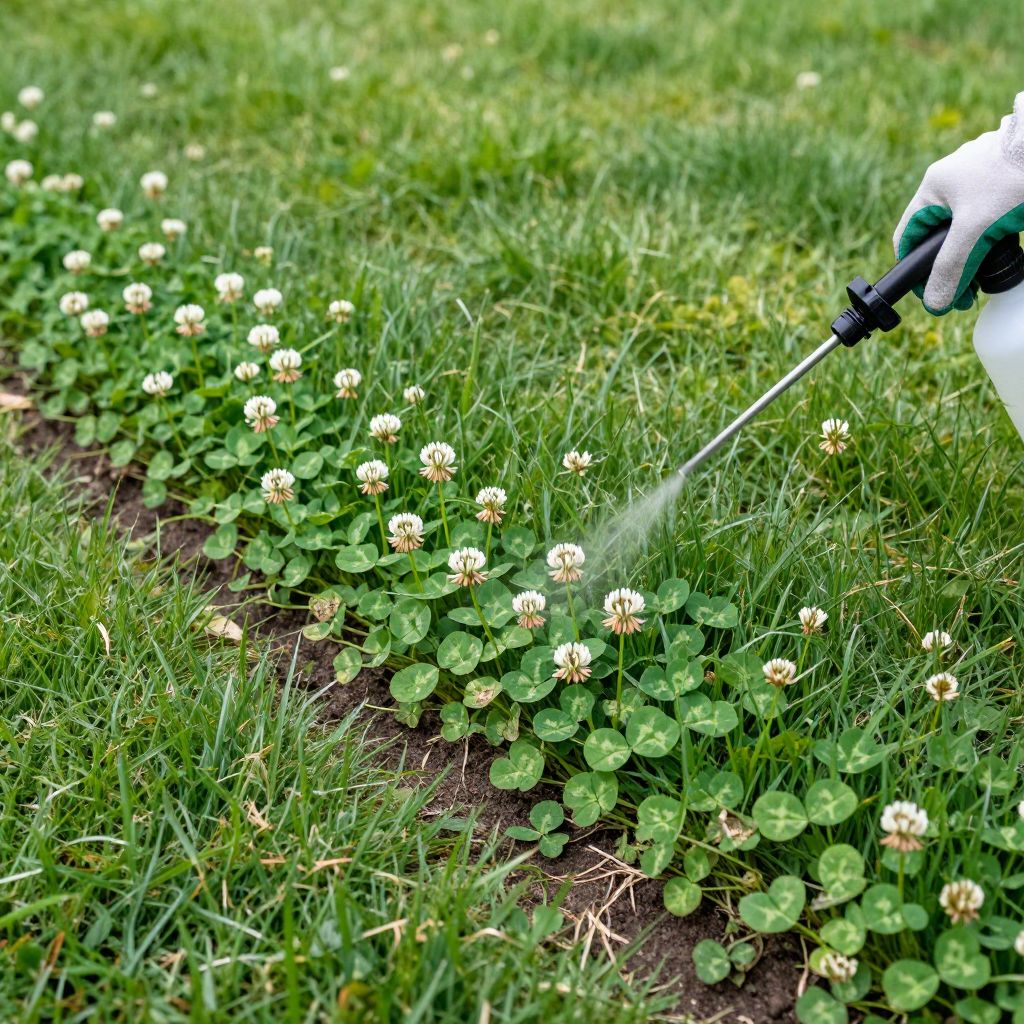
If you’re wondering what kills clover but not grass, the short answer is a selective broadleaf herbicide. These products target clover and other dicots while leaving turfgrasses unharmed when used correctly. The best results come from choosing the right product, applying it at the right time, and helping your lawn grow thick enough to crowd clover back out.
You can also reduce clover naturally by improving soil conditions and lawn care habits. Clover often shows up where grass is thin, compacted, or low in nitrogen, so the long-term fix is usually as much about lawn health as it is about weed control.
What kills clover but not grass?
Selective broadleaf herbicides kill clover without harming most lawn grasses because clover is a broadleaf plant and turfgrass is a narrow-leaved grass. Look for products labeled for lawns and broadleaf weeds, often containing ingredients such as 2,4-D, dicamba, MCPP, triclopyr, or combinations of these. Always follow the label exactly and avoid spraying stressed or newly seeded lawns.
Why clover appears in lawns
Clover is not always a sign of failure. It often moves into lawns where grass is struggling and open space is available.
Common reasons clover takes hold
- Low nitrogen in the soil, which favors clover over turfgrass.
- Thin turf from mowing too short, drought stress, shade, or traffic.
- Compacted soil that limits root growth and water movement.
- Poor drainage or uneven watering that weakens grass.
- Soil pH or fertility issues that make grass less competitive.
If you only spray the clover and never address the underlying lawn conditions, it often returns. A thicker, healthier lawn is one of the best long-term weed suppressors.
Best herbicide options for killing clover in grass
For established lawns, a selective broadleaf weed killer is usually the most direct solution. The key is to choose a product labeled for your turf type and follow the label carefully.
Active ingredients commonly used
- 2,4-D — widely used on many lawn weeds, including clover.
- Dicamba — often combined with other ingredients for better control.
- MCPP or mecoprop — commonly included in lawn weed mixes.
- Triclopyr — useful on tougher broadleaf weeds and some clover patches.
Many ready-to-use and concentrate lawn weed killers combine more than one active ingredient. That can improve control, especially on mature clover or mixed broadleaf weeds.
What to check before you spray
- Make sure the label says it is safe for your specific grass type.
- Check whether the lawn is a cool-season or warm-season turf.
- Confirm whether the product is safe for newly seeded areas.
- Look for any restrictions on temperature, rainfast time, or mowing.
Important: A product that is safe for Kentucky bluegrass may not be safe for all warm-season lawns, and some herbicides can injure certain turf varieties. The label is the final authority.
How to apply clover killer safely and effectively
Good application matters as much as product choice. Clover is easiest to control when it is actively growing and the lawn is not under drought or heat stress.
- Mow first if needed, but avoid scalping the lawn. Give the weeds some leaf area for the spray to contact.
- Apply on a calm day so drift does not reach ornamentals, vegetables, or nearby shrubs.
- Spray when temperatures are moderate, not during extreme heat or drought stress.
- Cover the clover leaves evenly, but do not drench the lawn.
- Keep people, pets, and irrigation off the treated area for the period listed on the label.
Timing tips
- Spring and early fall are often the best times because clover is actively growing.
- Avoid spraying during hot weather if the label warns against it.
- If the clover is flowering, control may still work, but thick patches may need a follow-up treatment.
Some clover species have a waxy leaf surface that can make coverage tricky. If the label allows it, a surfactant can improve wetting, but never add anything not approved by the product instructions.
Natural and non-chemical ways to reduce clover
If you prefer to avoid herbicides, you can still reduce clover, but it usually takes more time and consistency. These methods work best when the infestation is light to moderate.
Improve the lawn so grass wins
- Raise mowing height to encourage deeper roots and shade out weeds.
- Water deeply but infrequently, rather than giving shallow daily watering.
- Aerate compacted soil to improve root growth and water penetration.
- Overseed thin areas with the right grass for your site and climate.
- Use a soil test to guide lime or fertilizer decisions instead of guessing.
Because clover can fix nitrogen, it often survives where grass is nutrient-starved. A balanced fertility plan, based on soil testing, can make the lawn dense enough to reduce clover naturally.
Hand removal for small patches
For isolated clumps, dig out the plant with the roots and any creeping stems. Water the area lightly first if the soil is dry, because moist soil makes removal easier and reduces root breakage.
After removal, fill the bare spot with seed or topdress lightly with compost and overseed, depending on your lawn type and local conditions.
What not to do when treating clover
Some common mistakes make clover control less effective or damage the lawn you want to keep.
- Do not spray the wrong product. Non-selective herbicides kill grass as well as clover.
- Do not apply herbicide to a lawn that is heat-stressed, drought-stressed, or newly seeded unless the label specifically allows it.
- Do not mow too soon before or after treatment if the label recommends waiting.
- Do not assume one application will solve a heavy infestation.
- Do not use too much product in hopes of getting faster results.
Overapplication can scorch turf, damage nearby plants, and still fail to kill the clover completely. More is not better with lawn herbicides.
How long it takes to see results
Most selective broadleaf herbicides do not brown clover instantly. You may see twisting, yellowing, or stunting first, followed by decline over several days to a couple of weeks, depending on the product and weather.
If clover is still green after the expected window, check whether the lawn was too dry, too hot, or mowed too soon after treatment. Dense, mature clover patches sometimes need a second application if the label permits it.
Preventing clover from coming back
The best prevention is a thick lawn that leaves little room for weeds. Once you clear the clover, shift attention to lawn maintenance.
Long-term lawn habits that help
- Mow at the recommended height for your grass species.
- Feed the lawn according to soil test results and local recommendations.
- Repair bare spots quickly with seed or sod.
- Improve drainage in soggy areas if water regularly pools.
- Reduce soil compaction in high-traffic zones.
If clover keeps returning in the same places, those spots usually need more than weed control. Shade, poor soil, or traffic may be the real problem.
When clover may be worth keeping
Not every gardener wants a perfectly uniform lawn. Clover can provide a green, low-growing cover, and some people tolerate a small amount if the turf is otherwise healthy.
If you choose to keep some clover, manage it as part of the lawn rather than letting it spread unchecked. That means mowing regularly, preventing bare patches, and watching for areas where clover is replacing grass instead of mixing with it.
Quick answer for busy gardeners
If you want the simplest route, use a selective broadleaf lawn herbicide labeled for your grass type, apply it when clover is actively growing, and follow up by thickening the lawn with proper mowing, watering, and overseeding. That combination is usually more effective than spraying alone.
For more lawn-care help, you may also want to read about how to overseed a thin lawn and how to aerate compacted soil once those topics are available in your gardening library.