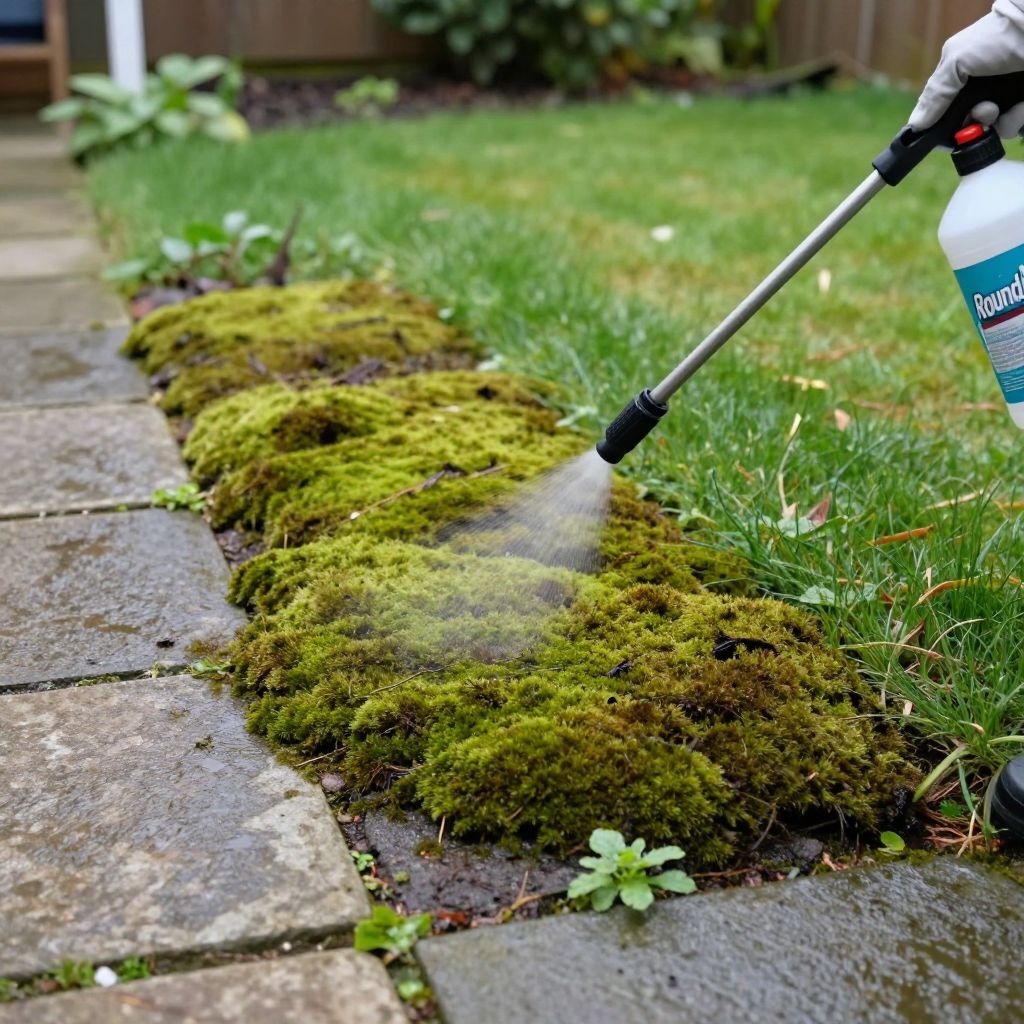
Does Roundup kill moss? If you’re seeing green, velvety patches in a lawn, driveway crack, or shady border, it’s natural to wonder whether a common weed killer will clear it fast.
The short answer is that Roundup can damage or kill moss on contact, but it is usually not the best long-term fix. Moss often returns unless you correct the damp, compacted, shaded, or acidic conditions that let it thrive.
Does Roundup kill moss?
Roundup, which contains glyphosate, may brown and weaken moss, but it is not designed as a reliable moss control product. In many cases, it works poorly on moss compared with dedicated moss killers, and it will not solve the moisture, shade, or soil problems that caused the moss in the first place.
Why moss grows where it does
Moss is not a “weed” in the usual sense. It is a simple plant that thrives where turf struggles, especially in cool, damp, low-light areas.
If moss is spreading in your garden, look for the underlying conditions rather than focusing only on the patch itself. Common causes include:
- Shade from trees, fences, or buildings
- Poor drainage or standing water
- Compacted soil with little air movement around roots
- Thin or weak grass that cannot compete
- Low fertility in turf areas
- Acidic soil, depending on the site and grass type
That is why moss often returns after spraying. The site still favors moss, even if the top growth is damaged.
What Roundup does and does not do
Roundup is a non-selective herbicide. It is intended to kill many green plants it contacts, but moss is not always controlled consistently because its structure and growth habit differ from weeds and turf grasses.
Here is the practical takeaway:
- It may burn back visible moss in some situations.
- It may miss moss tucked into cracks, thatch, or dense mats.
- It will also damage any grass, flowers, or ornamentals it touches.
- It does not correct drainage, shade, or compaction.
If you are treating moss in a lawn, using Roundup is usually a poor choice because it can leave dead patches of grass along with the moss. A moss-specific product or a cultural fix is often more effective.
Best ways to remove moss safely
The right method depends on where the moss is growing. A lawn, patio, roof, and shaded bed all need different approaches.
In lawns
- Rake out loose moss with a spring-tine rake or scarifier.
- Improve drainage by aerating compacted soil if needed.
- Reduce shade where possible by pruning overhanging branches.
- Overseed thin turf with a grass type suited to your light and climate.
- Adjust mowing height so grass can shade the soil without being scalped.
If you use a moss control product, read the label carefully and apply only to the intended area. Wait to overseed or reseed until the product label says it is safe.
On paths, patios, and paving
- Scrape or brush off the moss first.
- Use a stiff broom or patio brush to remove debris from joints and cracks.
- Apply a moss treatment labeled for hard surfaces if needed.
- Rinse or sweep away dead moss after it dries out.
- Check for drainage issues, such as low spots where water lingers.
Hard surfaces often need repeated cleaning because moss spores return to damp, shaded areas. Sealing cracks and improving runoff can help reduce regrowth.
In beds and around ornamentals
Moss in a border is not always a problem. In some shady, moist gardens, moss can be part of the look. If you want to remove it, focus on drying the site slightly and increasing airflow rather than reaching for a broad-spectrum herbicide.
Be especially careful near perennials, shrubs, and groundcovers. Roundup can injure anything green it touches, including desirable plants.
How to prevent moss from coming back
Long-term moss control is mostly about making the site less favorable to moss and more favorable to the plants you want.
Improve drainage
Waterlogged soil is one of the biggest reasons moss takes over. If water pools after rain, you may need to:
- Loosen compacted soil with core aeration
- Topdress with compost in thin layers where appropriate
- Regrade small low spots so water runs off
- Fix blocked gutters, downspouts, or runoff patterns nearby
In very wet sites, even a healthy lawn may struggle. In that case, consider groundcovers, gravel, or shade-tolerant planting instead of forcing turf where it will fail.
Reduce shade where possible
Moss loves low light. If tree canopies or hedges are creating deep shade, selective pruning can help, as long as you do it correctly and at the right time for the plant involved.
Do not over-prune mature trees just to chase more sun. A little more light may help turf, but heavy pruning can stress the tree and create other problems.
Strengthen the lawn
A dense, vigorous lawn is the best competition against moss. To support turf growth:
- Mow at the recommended height for your grass type.
- Avoid cutting off more than one-third of the blade at a time.
- Overseed thin patches when conditions suit germination.
- Use compost or a balanced lawn feed only if your soil test or local conditions suggest it.
Healthy grass is less likely to leave open, damp soil where moss can settle.
Common mistakes to avoid
Many moss problems persist because the treatment addresses only the symptom. Watch out for these common errors:
- Spraying first and asking questions later without checking the label or nearby plants
- Using Roundup on lawns and accidentally killing grass along with moss
- Ignoring drainage and expecting moss to stay away after treatment
- Overwatering shady areas that already stay damp
- Leaving bare soil exposed after removal, which invites moss back
Another mistake is assuming moss means your soil is always too acidic. Soil pH can matter, but shade and moisture are often bigger drivers. A simple soil test is more useful than guessing.
When a moss killer makes more sense than Roundup
If your goal is to remove moss from a lawn or hardscape, a product specifically labeled for moss is usually a better fit than glyphosate. These products are designed for moss control and may be formulated for lawns, patios, roofs, or other surfaces depending on the label.
Choose carefully based on where you are applying it:
- Lawn-safe products if you want to protect turf
- Hard-surface products for paving, walls, and paths
- Non-chemical removal if you prefer to avoid sprays entirely
Always read the label for temperature limits, rainfastness, safety precautions, and whether reseeding or replanting is allowed afterward.
What to do after the moss dies
Dead moss does not always disappear on its own. Once it turns brown, remove it so the area can dry and new growth can establish.
- Wait until the moss has fully browned or loosened.
- Rake, brush, or scrape away the dead material.
- Check the surface underneath for compaction, puddling, or bare soil.
- Repair the site with turf, mulch, gravel, or suitable groundcover.
- Monitor the area after rain to see whether the original problem is still present.
If moss returns quickly, the site still has the same conditions that favored it before. That is your clue to improve light, drainage, or soil structure rather than repeating the same spray.
Quick answer for gardeners
So, does Roundup kill moss? Sometimes it will damage moss, but it is not the most dependable or useful solution. For lawns and garden spaces, the best results come from removing the moss and fixing the conditions that let it grow: shade, moisture, compaction, and weak plant cover.
If you want to keep reading, a helpful next step is learning how to improve shady, damp garden spots and how to choose the right groundcover for difficult areas.