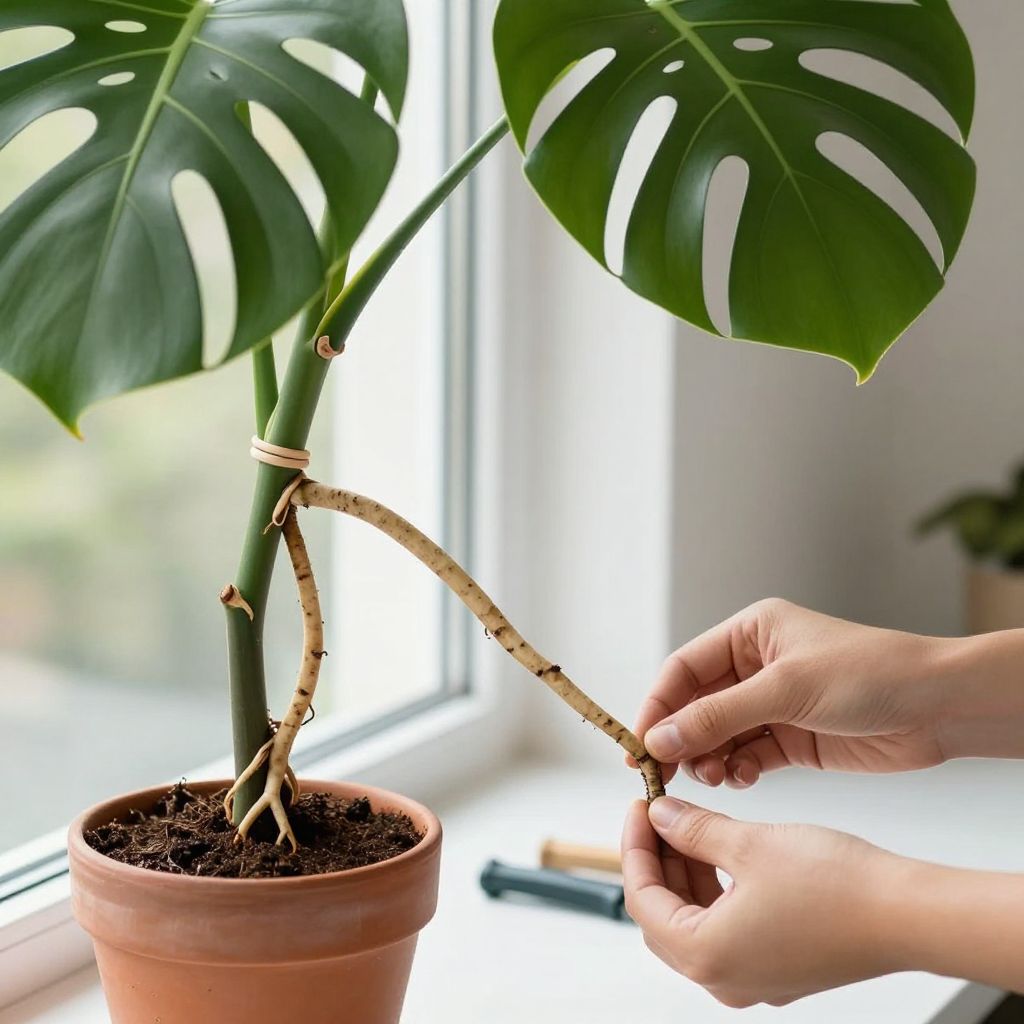
What should you do with Monstera aerial roots when they start reaching out of the pot? The short answer is: usually, let them be, guide them onto support, or trim them only if they’re truly in the way. Aerial roots are a normal part of Monstera growth, and how you handle them depends on the plant’s size, support, and growing conditions.
Handled well, these roots can help your Monstera climb, stay stable, and take up moisture and nutrients from a support or nearby medium. Handled poorly, they can be damaged, dried out, or cut too aggressively, which may stress the plant. Here’s how to decide what to do with them indoors or outdoors.
What to do with Monstera aerial roots?
Monstera aerial roots can be left alone, trained onto a moss pole or trellis, tucked into the potting mix if they fit naturally, or pruned if they’re damaged or inconvenient. The best choice depends on the plant’s size and support. Do not remove healthy aerial roots just because they look messy.
Why Monstera grows aerial roots
Most Monstera species, especially Monstera deliciosa, are natural climbers. In the wild, they use aerial roots to anchor themselves to trees and absorb moisture from bark, leaf litter, and humid air.
Indoors, those same roots often grow toward anything nearby: a stake, wall, curtain, or the floor. That behavior is normal and usually means the plant is maturing and looking for support.
What aerial roots do for the plant
- Support: They help the plant attach and climb.
- Moisture uptake: They can absorb water in humid conditions.
- Stability: They help large stems stay upright.
- Growth support: A well-supported Monstera often grows larger leaves over time.
Best ways to manage aerial roots
1. Leave them alone
If the roots are not causing a problem, the simplest option is often the best. Healthy aerial roots do not need to be cut, hidden, or forced back into the pot.
This is especially true if your Monstera is climbing a pole, growing in a bright room, or has room to spread. Aerial roots are part of the plant’s natural form.
2. Guide them onto a support
For most indoor Monsteras, the most useful approach is to train aerial roots onto a moss pole, coir pole, wooden plank, or trellis. This gives the plant something to climb and can improve its overall shape.
Use soft plant ties, Velcro garden tape, or loose clips to secure the main stem. Do not force the root sharply into position; instead, gently curve it toward the support.
If you use a moss pole, keep it lightly moist if possible. Aerial roots are more likely to attach when the support stays slightly damp and textured.
3. Tuck them into the potting mix
If an aerial root is long enough and flexible, you can sometimes guide it into the potting mix. This may help stabilize the plant, but only do this if the root fits naturally without breaking.
Use a chunky, airy mix that drains well. Monstera roots do best in a substrate with good oxygen flow, not in dense, soggy soil.
4. Trim them only when necessary
You can prune aerial roots if they are dead, broken, rotting, or getting in the way of furniture, walkways, or windows. A healthy root can also be shortened if the plant is becoming unmanageable, but only trim what you need to.
Use clean, sharp pruners or scissors. Make a clean cut close to the stem without nicking it. Avoid tearing or crushing the root.
How to tell whether an aerial root should be cut
Before you cut, check the root’s condition. Healthy aerial roots are usually firm and flexible, often tan, brown, or greenish depending on age and light exposure.
Keep it if the root is:
- Firm and intact
- Actively growing
- Attached to a support or moving toward one
- Long but not causing damage
Remove it if the root is:
- Dry, shriveled, or hollow
- Mushy, blackened, or foul-smelling
- Broken at the base
- Snagging badly on furniture or traffic areas
Never cut healthy roots just because they look untidy. The plant may be relying on them for support and moisture.
How to train Monstera aerial roots step by step
- Choose a support that is taller than the current plant.
- Place the support close to the main stem without crowding the pot.
- Gently lift the aerial root and direct it toward the support.
- Use soft ties to secure the stem, not the root itself.
- Keep humidity moderate to high if your indoor air is very dry.
- Check every few weeks and adjust ties as the plant grows.
If the root is stiff, don’t force it. Let it grow in the direction it wants, then reposition the support if needed.
Should you put aerial roots back into the pot?
Sometimes, yes, but only if the root can sit naturally in the mix. Forcing a long, woody root into a small pot can snap it or compact the substrate around the stem.
If the pot is already crowded, repotting may be a better solution than trying to cram roots back inside. Use a container with drainage holes and a chunky aroid mix that includes materials such as bark, perlite, and coco coir or peat-based components, depending on what you normally use.
Good reasons to repot
- The pot is rootbound
- The plant is top-heavy and unstable
- The mix breaks down and stays wet too long
- Aerial roots have nowhere to go and the plant needs more support
Indoor vs. outdoor Monstera care
Indoor plants
Indoors, aerial roots often grow toward windows, walls, or nearby objects because the plant is searching for support and light. This is normal, but you may want to train the roots to avoid damage to paint, plaster, or furniture.
Indoor air is often drier than Monstera prefers, so a support pole, regular watering when the top layer of mix dries, and moderate humidity can help roots stay healthier.
Outdoor plants
In warm climates where Monstera can grow outdoors, aerial roots may attach to trees, fences, or structures. Let them climb if the surface is safe and sturdy.
Be careful not to let roots invade fragile masonry, painted surfaces, or delicate bark. If the plant is growing in the ground, keep it away from structures you do not want it to cling to.
Common mistakes to avoid
- Cutting every aerial root: This can weaken the plant and remove its natural support system.
- Forcing roots into dry soil: This can break them and compact the root zone.
- Using a support that is too short: The plant will quickly outgrow it and flop again.
- Letting roots sit in constant wetness: This can encourage rot.
- Ignoring a top-heavy plant: Large Monsteras often need staking or repotting to stay stable.
What if the aerial root looks unhealthy?
If a root turns black, mushy, or starts to smell bad, check the potting mix and watering habits. Root problems often come from poor drainage, overwatering, or a pot that stays wet too long.
Trim the damaged root with sterilized tools, then inspect the base of the plant. If the main stem or underground roots are also soft or dark, the problem may be more serious than an isolated aerial root issue.
Signs the plant may need attention
- Leaves yellowing along with root decline
- Soil staying wet for many days
- Stem tissue softening near the base
- Foul odor from the pot
Can you propagate from aerial roots?
Aerial roots themselves are not usually enough to make a new plant. For propagation, you need a stem cutting with at least one node, and ideally an aerial root attached to that node.
If you are taking cuttings, make sure each section includes a node, because that is where new roots and leaves form. Place the cutting in water, sphagnum moss, or a suitable propagation medium until roots develop, then pot it up when the root system is established.
Practical maintenance tips for healthier aerial roots
- Provide a moss pole, trellis, or other sturdy support early.
- Use a chunky, well-draining potting mix.
- Water thoroughly, then let the top layer of mix dry slightly before watering again.
- Keep the plant in bright, indirect light for stronger growth.
- Raise humidity if your indoor air is very dry.
- Inspect roots and stems regularly for rot, pests, or damage.
Healthy aerial roots usually mean the plant is growing as it should. If the roots are vigorous but the plant looks weak, the issue is often support, light, or drainage rather than the roots themselves.
Final takeaway
When you’re deciding what to do with Monstera aerial roots, start by asking whether they’re healthy and whether they need support. In most cases, the best answer is to leave them, guide them onto a pole, or trim only damaged or inconvenient roots. If you want more Monstera care help, look for guidance on repotting, support poles, and indoor aroid soil mixes.
For more practical houseplant care, you may also find related reading on Monstera care basics and how to repot indoor plants.