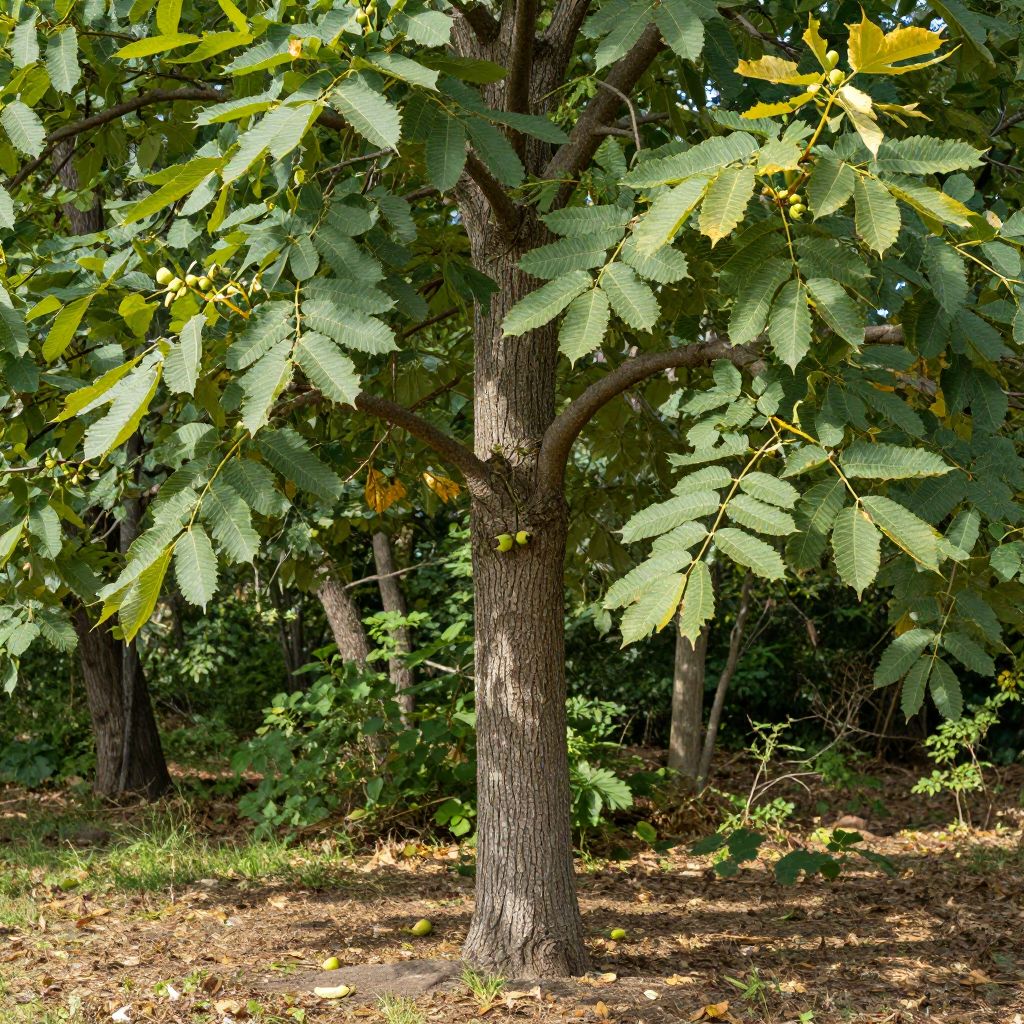
What does a hickory tree look like? If you’re trying to identify one in a yard, woodland edge, or older landscape, the answer comes down to a few reliable clues: compound leaves, shaggy bark on some species, and nuts with thick husks. Hickories are handsome native trees, but they’re easy to confuse with pecan, walnut, and ash at first glance.
The good news is that once you know what to look for in the leaves, bark, buds, and fruit, hickory identification becomes much simpler. This guide will help you recognize a hickory tree in every season and understand the growing conditions that keep it healthy in the landscape.
What does a hickory tree look like?
A hickory tree usually has long, pinnately compound leaves with 5 to 17 leaflets, gray to brown bark that may be ridged or shaggy, and round nuts enclosed in a thick green husk. Mature trees are tall, straight, and often develop a broad, open crown. In winter, the twigs, buds, and bark are the best identification clues.
Key features to identify a hickory tree
Leaves
Hickory leaves are compound, meaning each leaf is made of several leaflets attached to one central stem. Most species have 5 to 9 leaflets, though some can have more.
- Leaflets are usually lance-shaped or oval with pointed tips.
- Edges may be smooth or finely toothed, depending on the species.
- Leaves are arranged alternately along the twig, not directly opposite each other.
If you pick up a fallen hickory leaf, it often feels sturdy and slightly leathery compared with softer tree leaves. The central stem may be smooth or slightly hairy.
Bark
Bark is one of the easiest ways to recognize a hickory once the tree matures. Many hickories have gray bark with deep vertical ridges, while some species show a shaggy, peeling look.
- Shagbark hickory is famous for long strips of loose bark that curl away from the trunk.
- Shellbark hickory also has shaggy bark, often with broader strips.
- Other hickories may have tighter, more deeply furrowed bark without the shaggy peeling.
Young hickories do not always show dramatic bark, so don’t rely on bark alone if the tree is still small.
Twigs and buds
In winter, hickory twigs are helpful for identification. They are usually stout, and the terminal buds are often large and distinctive.
- Buds are typically covered with overlapping scales.
- Some species have yellowish or tan buds that stand out against the twig.
- Leaf scars on the twig can help separate hickories from similar trees.
Walnut twigs can look similar, but hickory buds are often more robust and the leaf scars tend to be more obvious.
Nuts and husks
Hickory fruit is a round or oval nut surrounded by a thick husk. As the fruit matures, the husk usually splits into four sections and releases the nut.
- Nuts are hard-shelled and often edible, though some species have very thick shells.
- The husk is green when immature and turns brown as it dries.
- Fallen husks and nuts around the base of the tree are a strong clue that you have a hickory nearby.
Be aware that pecan is also a hickory relative, so a tree with similar nuts may be a pecan rather than a true hickory species.
Common hickory species and how they differ
Shagbark hickory
Shagbark hickory (Carya ovata) is one of the most recognizable species because of its loose, peeling bark. It usually has five leaflets on mature leaves, though some leaves may have seven.
This species is often the first one people picture when they ask what a hickory tree looks like.
Shellbark hickory
Shellbark hickory (Carya laciniosa) also has shaggy bark, but it tends to be a larger tree with broader leaflets and larger nuts. It often grows in richer, moister soils than shagbark hickory.
Pignut hickory
Pignut hickory (Carya glabra) usually has tighter bark and smaller nuts with thinner husks. It is less shaggy than shagbark and can be harder to identify without close inspection of the leaves and fruit.
Mockernut hickory
Mockernut hickory (Carya tomentosa) has large leaves with many leaflets and a thick husk around the nut. The underside of the leaves may feel fuzzy or hairy, which is a useful clue.
Pecan
Pecan (Carya illinoinensis) is in the same genus as hickories, so it shares many traits. It usually has longer, narrower leaflets and produces elongated nuts rather than the rounder nuts of many wild hickories.
Where hickory trees grow best
Hickories are outdoor trees that prefer full sun and deep, well-drained soil. They are long-lived, slow to moderate growers, and do best when given plenty of room to mature.
- Sunlight: Full sun is ideal for strong growth and good canopy development.
- Soil: Deep, fertile, well-drained soil supports the best root growth.
- Drainage: Hickories dislike waterlogged soil and compacted sites.
- Space: Mature trees need room for a wide root system and large crown.
If you are planting one, choose a site where the roots will not be crowded by pavement, foundations, or repeated digging.
How to tell hickory apart from similar trees
Hickory vs. walnut
Walnuts also have compound leaves, but their leaflets are often broader and the overall leaf may smell strongly aromatic when crushed. Walnut bark is usually more deeply furrowed and less likely to peel in long shaggy strips.
Hickory vs. ash
Ash trees also have compound leaves, but their leaflets are usually arranged in opposite pairs along the stem, while hickory leaflets are arranged alternately. Ash bark and buds are also different, and ash does not produce the same thick-husked nut.
Hickory vs. pecan
Pecan is the trickiest comparison because it belongs to the same genus. The easiest difference is the nut shape: pecans are more elongated and pointed, while many hickory nuts are rounder and enclosed in thicker husks.
Seasonal identification tips
Spring and summer
During the growing season, focus on leaves, leaf arrangement, and the developing fruit. Healthy hickory leaves are usually medium to dark green and can cast dense shade once the canopy fills in.
Autumn
Fall is a good time to look for nuts, husks, and leaf color changes. Many hickories turn yellow before dropping their leaves, and the ground beneath the tree may be littered with fruit.
Winter
In winter, use bark, twigs, buds, and tree form. A mature hickory often has a tall trunk and a rounded or spreading crown, even when leafless.
Growing and caring for a hickory tree in the landscape
If you’re planting a hickory tree, think long term. These are not small ornamental trees; they can become large, shade-giving canopy trees that need time and space.
Planting tips
- Choose a location with full sun and deep soil.
- Check that drainage is good after rain.
- Dig a planting hole only as deep as the root ball and wider than the root ball.
- Set the tree at the same depth it grew in the nursery container or field ball.
- Backfill with native soil unless a soil test or local conditions suggest a specific amendment.
- Water thoroughly after planting and mulch the root zone with a thin layer, keeping mulch away from the trunk.
Young trees benefit from regular watering during establishment, especially in hot or windy weather, but avoid keeping the soil soggy. The goal is evenly moist soil, not constant saturation.
Pruning
Prune hickories lightly when young to remove damaged, crossing, or poorly placed branches. Mature trees usually need only occasional corrective pruning.
- Remove dead, broken, or rubbing branches first.
- Keep a strong central leader if you are training a young tree.
- Avoid heavy pruning in one season, which can stress the tree.
If a large limb must be removed, use proper tree-pruning cuts or hire a certified arborist. Large wounds on slow-growing trees can take a long time to close.
Common pests and diseases
Hickories are generally sturdy, but they can still face pest and disease problems, especially when stressed by poor drainage, compacted soil, or drought.
Possible pest issues
- Leaf-feeding caterpillars
- Scale insects on twigs and branches
- Nut pests that damage developing fruit
Possible disease issues
- Leaf spots during wet weather
- Root stress or decline in poorly drained soil
- Branch dieback after drought or injury
The best prevention is good culture: adequate space, proper watering, healthy soil, and prompt removal of dead wood. If you notice widespread canopy thinning, unusual sap flow, or repeated dieback, a local arborist or extension office can help you narrow down the cause.
Propagation and natural regeneration
Hickories can be grown from seed, but germination is slow and uneven because the nuts have dormancy requirements. In nature, seedlings often appear where squirrels bury nuts and forget them.
If you collect seed, use only fresh, viable nuts from healthy trees and follow local guidance for cold stratification and sowing. For most home gardeners, buying a young tree from a reputable nursery is the easier option.
Practical mistakes to avoid
- Don’t identify by bark alone. Young trees may not show mature bark traits yet.
- Don’t confuse hickory with ash or walnut just because the leaves are compound.
- Don’t plant in wet ground where roots can stay saturated.
- Don’t crowd the trunk with mulch. Keep mulch pulled back from direct contact.
- Don’t overprune. Hickories are slow to recover from unnecessary cutting.
Quick identification checklist
Use this checklist if you are standing under a tree and want a fast answer:
- Are the leaves compound with several leaflets?
- Are the leaflets arranged alternately along the stem?
- Does the bark look ridged or shaggy on a mature tree?
- Are there round nuts with thick husks on the ground?
- Is the tree tall, straight, and open-crowned at maturity?
If you can answer yes to most of these, you are likely looking at a hickory or a close relative such as pecan.
Conclusion
When you ask what does a hickory tree look like, the best answer is: look for compound leaves, sturdy twigs, gray ridged or shaggy bark, and thick-husked nuts. Once you know those traits, hickory becomes much easier to identify in every season. If you’re still unsure, compare the leaves and bark with other nut trees nearby and take a closer look in fall or winter.
For more help identifying trees in the landscape, you may also find this guide useful: what type of tree is this?