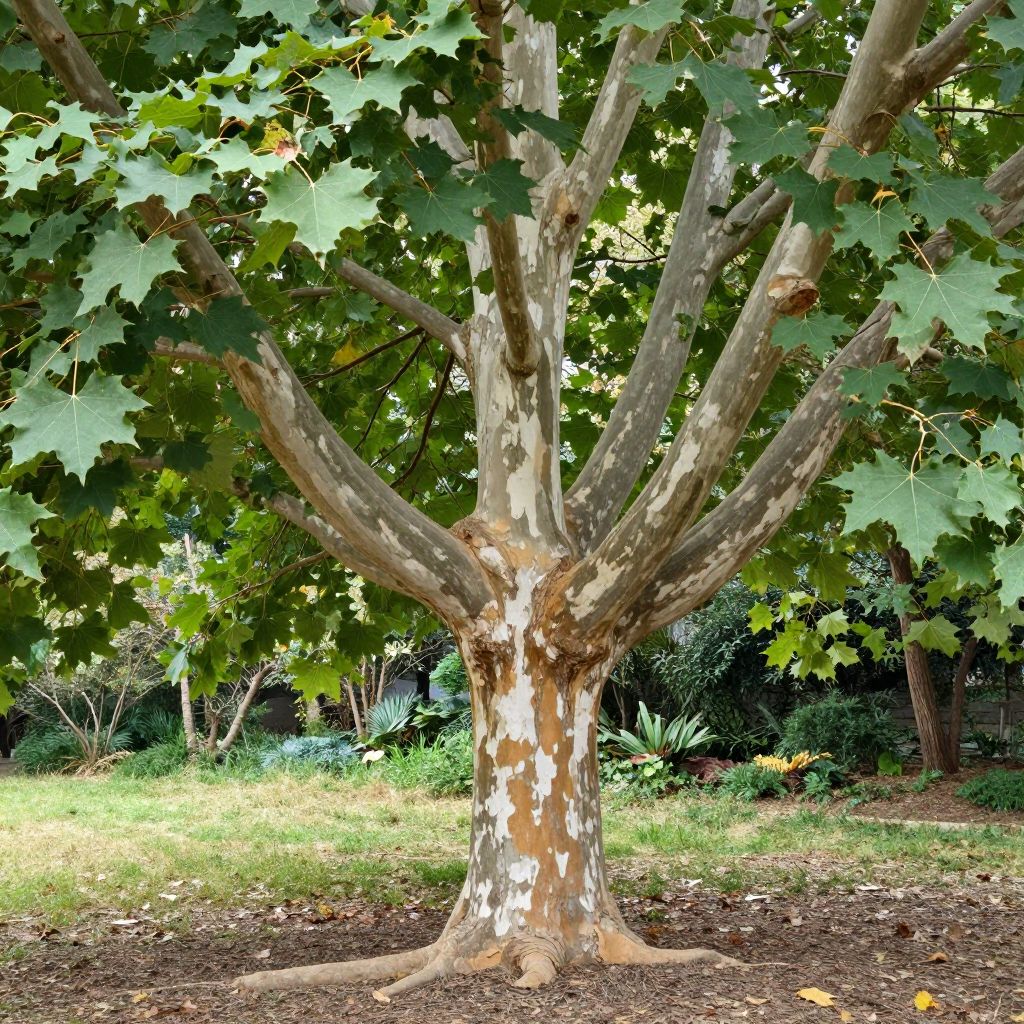
If you’re wondering, “What does a sycamore tree look like?” the answer depends a little on age and species, but sycamores are usually easy to spot once you know the key features. They are large, broad-canopied trees with mottled bark, big lobed leaves, and round seed balls that often hang on the branches through winter.
In gardens and landscapes, sycamores are valued for shade and presence, but they need room to grow. Learning how to identify one correctly helps you decide whether it belongs in your yard and how to care for it if it does.
What does a sycamore tree look like?
A sycamore tree is typically a tall, fast-growing deciduous tree with a wide crown, large maple-like leaves, and distinctive bark that peels or flakes to reveal patches of cream, gray, tan, or green. Mature trees often have a massive trunk and hanging seed balls that remain visible after leaf drop.
Key features for identifying a sycamore tree
Leaves
Sycamore leaves are broad and usually 4 to 10 inches across, with 3 to 5 shallow lobes and a coarse, toothed edge. They look somewhat like maple leaves, but they are often larger and thicker, with a rougher texture.
The upper surface is usually dark green, while the underside is paler. In autumn, the leaves turn yellow-brown and drop relatively late compared with many other deciduous trees.
Bark
The bark is one of the easiest clues. On younger trunks, it may be smoother and gray, but as the tree matures it becomes patchy and exfoliating, creating a camouflage-like pattern of white, green, tan, and brown.
This mottled bark is a hallmark feature and is often the fastest way to recognize a sycamore from a distance.
Shape and size
Sycamores are large shade trees with a broad, spreading canopy. In open spaces they often develop a heavy, rounded crown and thick limbs that extend outward rather than forming a narrow, upright shape.
They can become very large, so a young sycamore may look modest at first but quickly outgrow a small garden if conditions are favorable.
Flowers and seed balls
Sycamores produce small, inconspicuous flowers in spring. The more noticeable feature is the round seed ball, usually about 1 inch across, which hangs from long stalks.
These seed balls often persist into winter and may break apart gradually, releasing fluffy seeds. If you see multiple hanging balls on bare branches, that is another strong identification clue.
How to tell a sycamore from similar trees
Sycamore vs. plane tree
In many regions, “sycamore” may refer to a plane tree, especially the London plane (Platanus × acerifolia). The two are closely related and look very similar, with mottled bark and ball-like seed clusters.
If you are identifying a street tree or landscape tree, the bark pattern and seed balls may be enough to place it in the sycamore/plane tree group, even if the exact species is unclear.
Sycamore vs. maple
Maples also have lobed leaves, but most do not have the same patchy, shedding bark. Maple leaves are often more sharply pointed, and many maples have paired winged seeds rather than round seed balls.
Sycamore vs. poplar or cottonwood
Poplars and cottonwoods can be large and fast-growing, but their leaves are usually more triangular or heart-shaped, and their bark does not usually show the same camouflage-like peeling effect.
Where sycamores grow best
Sycamores are outdoor trees that do best in full sun and in soil that stays evenly moist but drains reasonably well. They are often found near streams, low ground, parks, and large open yards where roots have room to spread.
They tolerate a range of soils, but they generally perform best in deep soil with consistent moisture. Very dry, compacted, or cramped sites can lead to stress, sparse growth, and earlier leaf drop.
Soil and drainage
- Best soil: deep, fertile, loamy soil
- Acceptable soil: clay or sandy soil if moisture is adequate
- Avoid: waterlogged sites with poor drainage for long periods
- Helpful amendment: compost worked into the planting area, if needed, to improve organic matter
Do not over-amend the planting hole with rich compost alone. A sycamore does better when the surrounding soil encourages roots to move outward naturally.
Planting a sycamore tree in the landscape
If you are planting a sycamore, choose the site carefully before you dig. These are large trees, so think about mature height, spread, overhead wires, foundations, driveways, and underground utilities.
- Select a site with full sun and enough open space for the mature canopy.
- Check for local restrictions or utility lines before planting.
- Dig a hole as deep as the root ball and 2 to 3 times as wide.
- Set the tree so the root flare sits at or slightly above soil level.
- Backfill with the native soil you removed, breaking up large clods.
- Water deeply to settle the soil and remove air pockets.
- Mulch with 2 to 3 inches of organic mulch, keeping it away from the trunk.
Avoid planting sycamores too close to patios, sewer lines, or small structures. Their roots and canopy can become very large over time.
Watering and early care
Young sycamores need regular moisture while they establish, especially during hot or windy weather. The goal is deep, thorough watering rather than frequent shallow sprinkling.
Check the soil a few inches below the surface. If it feels dry, water slowly so moisture reaches the root zone. Mature trees are more tolerant, but prolonged drought can still cause stress, leaf scorch, and premature leaf drop.
Mulching tips
- Use wood chips, shredded bark, or leaf mold.
- Keep mulch 2 to 3 inches deep.
- Leave a gap around the trunk so the bark stays dry.
- Refresh mulch as it breaks down, rather than piling it higher and higher.
Pruning and maintenance
Sycamores usually need only light structural pruning when young and occasional cleanup later. The best time for major pruning is often during dormancy or in the cooler part of the year, depending on your climate and local tree-care guidance.
Remove dead, damaged, or crossing branches first. If the tree is young, you can encourage a strong central structure by selecting one main leader and well-spaced side branches.
Pruning mistakes to avoid
- Do not remove too much at once.
- Do not top the tree.
- Do not leave long stubs.
- Do not prune heavily during extreme heat or drought stress.
If a mature sycamore is large or near structures, hire a qualified arborist for major pruning. Heavy limbs can be dangerous, and improper cuts can weaken the tree.
Common pests and diseases
Sycamores can be affected by several pests and diseases, especially when stressed by poor planting, drought, compacted soil, or repeated injury.
Pests
- Sycamore lace bug: causes stippling, pale leaves, and speckled undersides
- Scale insects: may appear as small bumps on stems and branches
- Bagworms or caterpillars: can defoliate young trees in some areas
Diseases
- Anthracnose: a common fungal issue that can cause leaf browning, blight, and twig dieback in cool, wet springs
- Powdery mildew: a white coating on leaves in humid conditions
- Root stress and cankers: more likely when the tree is planted poorly or damaged
Good cultural care is the first defense: proper spacing, even moisture, mulch, and cleanup of fallen leaves when disease pressure is high. Severe or recurring problems may need professional diagnosis.
Propagation and replacement options
Home gardeners usually do not propagate sycamores for casual use unless they have a large site and a clear plan for the mature tree. They are most often grown from seed or nursery stock, with nursery-grown trees being the easiest and most reliable choice.
If you want the look of a sycamore but do not have room for a full-sized tree, consider a smaller native tree or ornamental species better suited to compact gardens. Matching the tree to the site is always better than trying to control a tree that will outgrow it.
When a sycamore is a good choice for your garden
A sycamore can be a strong landscape choice if you need a large shade tree, have deep soil, and can give it plenty of room. It works well in parks, large lawns, and open properties where its broad canopy can develop naturally.
It is usually not a good fit for small yards, narrow side gardens, or places where roots and leaf litter would be a problem. The tree’s beauty comes with size, shedding bark, seed balls, and a fairly bold presence.
Quick identification checklist
- Large deciduous tree with a broad canopy
- Big, lobed leaves that resemble oversized maple leaves
- Mottled bark with cream, gray, tan, and green patches
- Round seed balls hanging from branches
- Often found in moist, open sites
Conclusion
If you are still asking what a sycamore tree looks like, focus on the bark, leaves, and seed balls. Those three features usually make identification much easier than size alone. If you think you have one in your yard, take a closer look in both summer and winter to confirm the markings and growth habit.
For more help identifying trees in your garden, you may also find this guide useful: what type of tree is this?