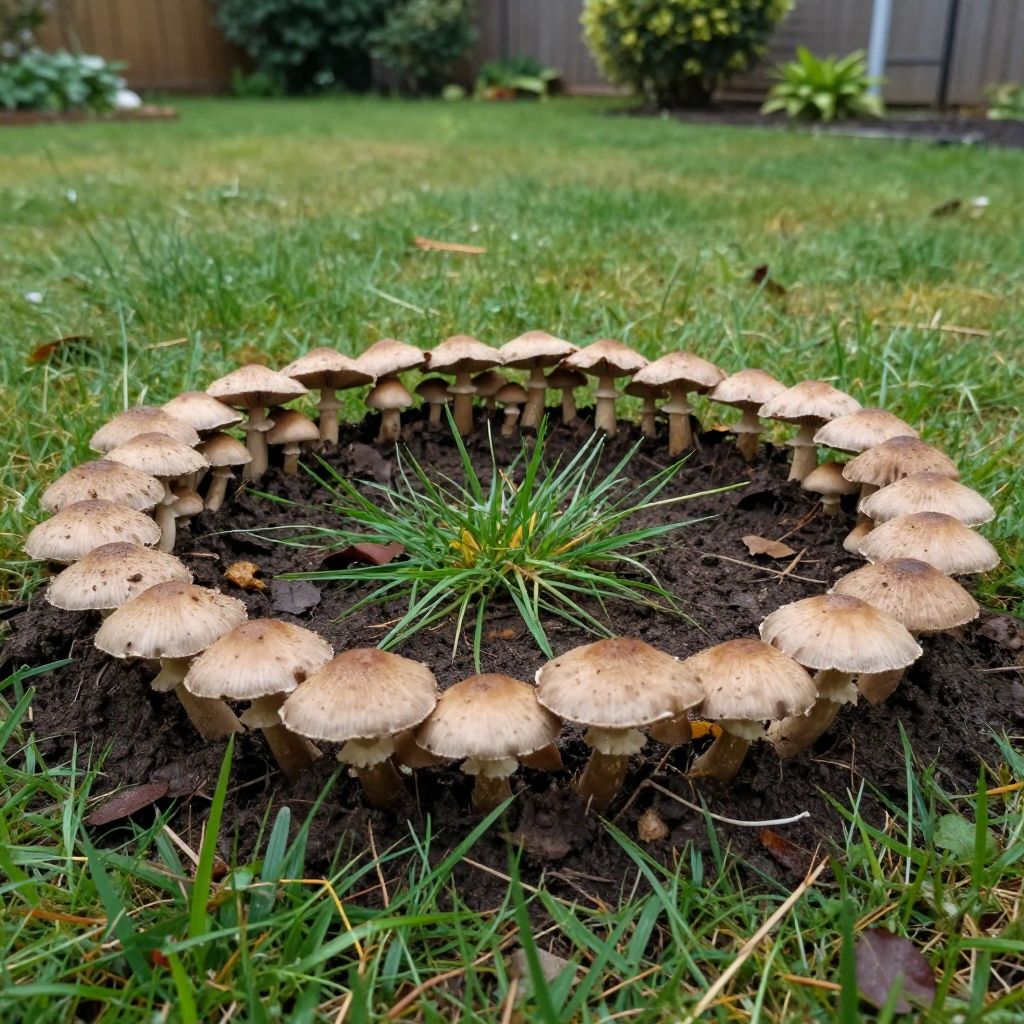
Why do mushrooms grow in a circle in your lawn, garden bed, or compost area? In most cases, it’s because a fungus is spreading outward underground from one central point, feeding on buried organic matter such as old roots, wood, or thatch. The visible mushrooms are just the fruiting bodies, and the ring is a sign of how the fungus grows.
Most fairy rings are not dangerous, but they can affect turf, soil moisture, and plant health. The good news is that you can usually manage them with better watering, aeration, and by improving drainage and soil conditions instead of reaching for a quick fix.
Why do mushrooms grow in a circle?
Mushrooms grow in a circle because many fungi spread outward in a roughly even ring from a central food source. As the underground mycelium expands, it fruits at the outer edge where conditions are best, creating the familiar circle or arc. This pattern is often called a fairy ring.
What causes circular mushroom growth?
Circular mushroom growth usually starts when a fungus colonizes something buried in the soil. Over time, it expands outward in all directions, and mushrooms appear where the fungus is most active and moisture is right.
Common triggers in lawns and beds
- Buried wood or roots from old stumps, construction debris, or landscape timbers
- Excess thatch in turfgrass, which gives fungi food to break down
- Rich organic matter in composty garden soil or mulch layers
- Compacted soil that holds moisture unevenly and limits airflow
- Wet weather or frequent irrigation that encourages fruiting
In many cases, the mushrooms are not the problem themselves. They are a sign that a fungus is decomposing organic material underground, which is a normal part of soil life.
Are circle mushrooms bad for your garden?
Not always. Some fairy rings are mostly cosmetic, while others can cause dry patches, dense dark green grass, or dead turf in the center or along the ring. In garden beds, they may simply indicate active decomposition. The impact depends on the fungus, soil conditions, and what is growing nearby.
Signs the ring is causing trouble
- Grass in the ring turns dark green and lush from released nitrogen
- Dry, water-repellent soil develops in the ring or center
- Patches of turf thin out, yellow, or die
- Mushrooms return repeatedly after rain or irrigation
If the lawn looks healthy and the mushrooms only appear after wet weather, you may not need to do much. If the area becomes patchy or hard to water, then management is worthwhile.
How to identify a fairy ring in the garden
Fairy rings can appear as a full circle, a half-circle, or a widening arc if the fungus hits an obstacle like a path, bed edge, or tree root. The mushrooms may be white, tan, brown, or even small and button-like depending on the species.
What to look for
- A ring or arc of mushrooms, often after rain
- Greener or faster-growing grass along the edge
- A dry, spongy, or water-repellent patch in the center
- Uneven growth that slowly expands outward over time
Remember that not every ring of mushrooms is a fairy ring in the strict sense. Sometimes a buried stump, old mulch pile, or patch of compost creates a similar pattern.
How to manage mushrooms growing in circles
The best solution is to improve the conditions that favor the fungus, not just remove the mushrooms you can see. Picking mushrooms may tidy the area, but it does not remove the underground mycelium.
Step-by-step control for lawns
- Remove the mushrooms before they release spores if you want to reduce spread and keep the area tidy.
- Rake out excess thatch if the lawn has a thick organic layer.
- Aerate compacted soil so water and air can move through the root zone.
- Water deeply but less often to encourage even moisture rather than constant dampness.
- Improve drainage if water pools or the soil stays soggy after rain.
- Topdress lightly with compost or soil only if needed to level the lawn; avoid burying the grass crown.
Step-by-step control for garden beds
- Check for buried wood, old roots, or construction debris.
- Reduce thick mulch layers if they are staying wet and breaking down too slowly.
- Loosen compacted soil gently without disturbing plant roots too much.
- Adjust watering so the bed dries slightly between waterings, depending on the plants growing there.
- Keep mulch a few inches away from stems and trunks to prevent excess moisture buildup.
When you should dig out the source
If a fairy ring keeps returning in the same spot, there may be buried wood, a stump, or a large root mass feeding it. In that case, the long-term fix is often removal of the source material, if practical and safe to do so.
Digging considerations
- Excavate only where you can do so without damaging desirable roots or utilities.
- Remove visible woody debris, old mulch pockets, and buried stumps if accessible.
- Refill with suitable soil and re-establish the area gradually.
If the fungus is growing near mature trees, be cautious. Digging too aggressively can damage roots and create a bigger problem than the mushrooms themselves.
How watering affects mushroom rings
Watering habits strongly influence whether mushrooms appear. Fungi are more likely to fruit when the soil is moist, especially after dry spells followed by rain or irrigation. Uneven watering can also make the ring more noticeable.
Better watering practices
- Water early in the day so surfaces dry faster.
- Avoid frequent shallow watering that keeps the top layer damp.
- Match irrigation to your soil type, weather, and plant needs.
- Let the soil surface dry somewhat between waterings unless you are growing moisture-loving plants.
For lawns, deep and less frequent watering usually supports stronger roots and reduces the damp conditions fungi prefer. For beds, group plants with similar water needs together so you do not overwater one area to suit another.
Can you eat mushrooms from a fairy ring?
Do not eat them unless you are absolutely certain of the species and have confirmed it with a trusted local expert. Many mushrooms look similar, and some are toxic. A ring in the lawn does not make a mushroom safe or edible.
If children or pets use the area, it is sensible to remove the mushrooms promptly. Even non-toxic species can cause stomach upset if eaten.
How to prevent mushrooms from coming back
You cannot always stop fungi from living in soil, and that is not the goal. The goal is to make your garden less favorable for repeated fruiting in the same spot.
Prevention checklist
- Remove buried wood, old roots, and construction scraps during bed preparation
- Keep mulch layers moderate and avoid piling them deep against plants
- Reduce thatch in lawns with regular maintenance
- Improve drainage in low spots
- Water only as needed for the plants and season
- Monitor shaded, damp areas more closely after rain
Important: Fungicides are usually not the best answer for fairy rings in home gardens. They rarely solve the underlying cause, and soil improvement is often more effective over time.
Common mistakes to avoid
Many gardeners try to solve the visible mushrooms without addressing the soil conditions underneath. That often leads to repeated outbreaks.
What not to do
- Do not keep overwatering the area after mushrooms appear.
- Do not assume the mushrooms are the problem rather than a symptom.
- Do not bury the area under more mulch or compost if it is already too rich and wet.
- Do not dig deeply around tree roots unless you know what is underground.
- Do not rely on one-time removal if the ring has an ongoing food source.
When to call a professional
Consider getting help if the ring is large, keeps expanding, or is causing serious lawn decline. A turf professional, arborist, or experienced local extension service can help identify whether the issue is a fairy ring, a buried stump, or another soil problem.
If the mushrooms appear in a bed near valuable shrubs or trees, professional advice is especially useful before you disturb the soil.
Bottom line
Why do mushrooms grow in a circle? Because the fungus is spreading outward underground from a central food source, and the mushrooms appear where conditions are right at the edge. In most gardens, the best fix is to improve drainage, reduce excess organic buildup, and manage watering rather than trying to eliminate every mushroom.
If you want to keep learning about healthy soil and lawn care, you may also find related gardening reading helpful on fungal issues, compost management, and improving drainage in problem areas.