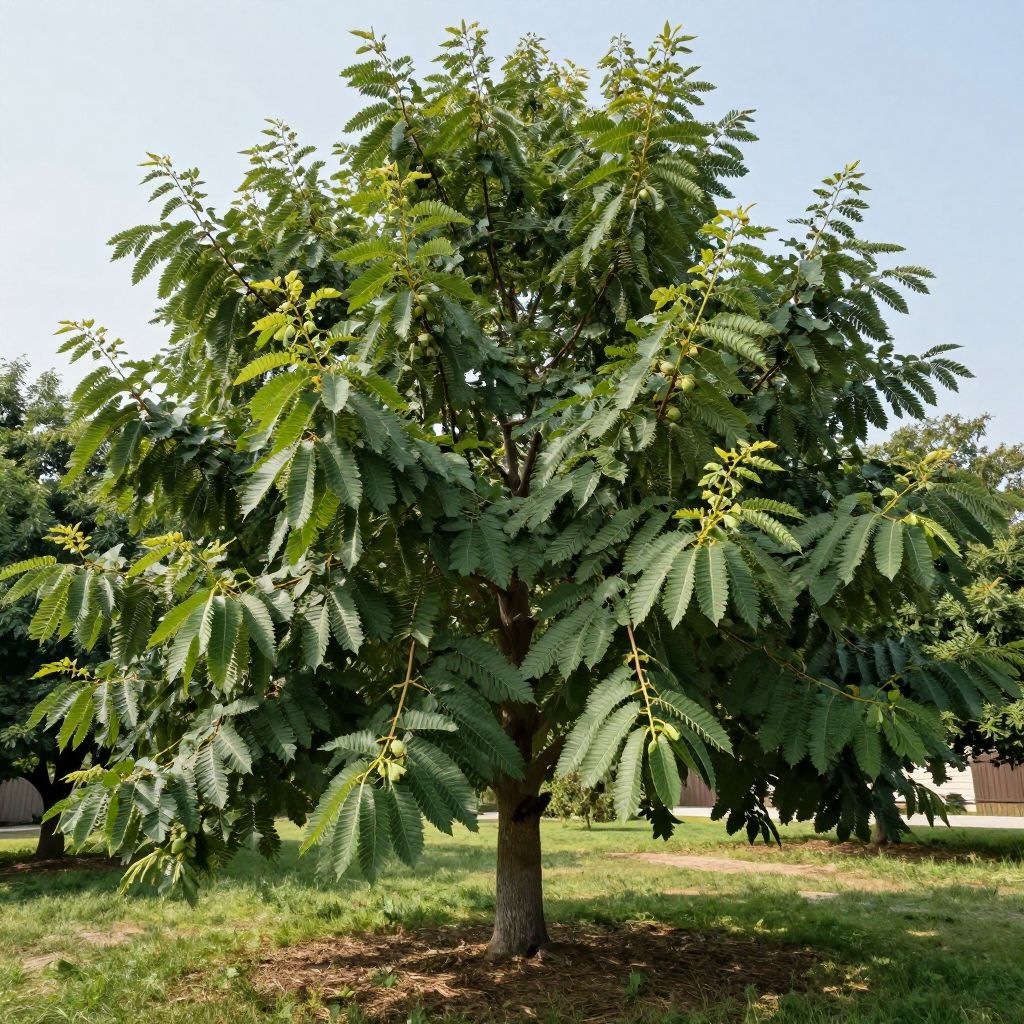
If you’re asking, “What does a pecan tree look like?” you’re probably trying to identify one in a yard, pasture, or along a roadside. Pecan trees are large, deciduous nut trees with long compound leaves, a tall upright trunk, and a broad rounded canopy as they mature.
They are native to North America and can become impressive landscape trees, but they are also easy to misidentify when young. The clues are in the leaves, bark, overall shape, and the nuts or husks they produce later in the season.
What does a pecan tree look like?
A pecan tree (Carya illinoinensis) is a tall, fast-growing deciduous tree with a straight trunk, spreading crown, and pinnate leaves made up of many narrow leaflets. Mature trees often reach 70 to 100 feet or more, with rough gray-brown bark and hanging clusters of nuts enclosed in green husks.
How to identify a pecan tree by its main features
Leaves
Pecan leaves are one of the easiest identification clues. Each leaf is compound, usually 12 to 20 inches long, with 9 to 17 slender, pointed leaflets arranged along a central stem.
- Leaflets are narrow and lance-shaped.
- Edges are usually finely toothed.
- The leaf surface is medium green and smooth to slightly glossy.
- Leaves turn yellow in fall before dropping.
Bark
Young pecan trees have smoother bark, but older trees develop gray to brown bark with long, narrow ridges and shallow furrows. The bark becomes more rugged with age, which helps distinguish mature trees from many other shade trees.
Tree shape and size
Pecans grow into large, open-canopied trees with a strong central trunk when young and a broad spreading crown as they mature. In open space, the canopy can become wide and irregular, especially if the tree has grown without competition.
Flowers and nuts
Pecan trees produce male and female flowers on the same tree. The flowers are not especially showy, so most people notice the nuts first. The fruit is an elongated nut enclosed in a green husk that splits open when ripe, releasing the shell inside.
- Unripe husks are green and smooth.
- Ripe husks split into sections as the nut matures.
- The nut shell is thin and oblong, with a pointed end.
How to tell pecan trees apart from similar trees
Several trees can look a little like pecans, especially when they are young. The best way to avoid confusion is to compare leaf structure, bark, and fruit together rather than relying on one feature alone.
Pecan vs. hickory
Pecans are in the hickory family, so they look related. The difference is that pecan leaflets are often narrower and more numerous, and pecan nuts are usually more elongated and smoother than many other hickory nuts.
Pecan vs. walnut
Walnuts also have compound leaves, but walnut leaflets are often broader and fewer. Walnut fruits are rounder and have a thicker outer husk, while pecan husks are thinner and split more cleanly at maturity.
Pecan vs. ash
Ash trees also have compound leaves, but their leaflets are usually arranged in opposite pairs and often have a more symmetrical look. Pecan leaflets alternate along the stem, which is a useful clue.
Where pecan trees grow best
If you are planting one, pecan trees do best in full sun and deep, fertile, well-drained soil. They need room, because mature trees become very large and their roots spread widely.
- Sunlight: Full sun is best for strong growth and nut production.
- Soil: Deep soil with good drainage is ideal.
- Space: Allow plenty of room away from buildings, driveways, and overhead lines.
- Moisture: Regular moisture helps young trees establish, but standing water can cause root problems.
Pecans tolerate a range of soils better than many fruit trees, but they perform poorly in compacted, shallow, or waterlogged ground. If your soil stays wet after rain, improve drainage or choose another site.
Planting and early care for pecan trees
When planting a pecan tree, the goal is to help it establish a deep root system. Young trees need careful handling, but once established they become more resilient.
- Choose a sunny site with enough space for mature size.
- Dig a hole as deep as the root ball and wider than it is deep.
- Set the tree so the root flare sits at or slightly above soil level.
- Backfill with native soil unless you have a serious drainage issue.
- Water thoroughly to settle the soil.
- Mulch in a wide ring, keeping mulch a few inches away from the trunk.
Avoid planting too deep. Burying the root flare is a common mistake that can weaken the tree over time.
Watering young pecans
Young pecan trees need consistent moisture while they establish, especially during hot, dry weather. Water deeply and less often rather than giving shallow, frequent sprinklings. Adjust based on rainfall, soil type, and temperature.
Mulch and soil care
A 2- to 4-inch layer of mulch helps conserve moisture and suppress weeds. Keep mulch away from the trunk to prevent rot and pest problems. If your soil is poor, a light top-dressing of compost around the root zone can help, but avoid piling compost against the trunk.
Pruning and maintenance
Pecan trees do not need heavy pruning every year, but young trees benefit from structural training. The aim is to develop a strong framework with good branch spacing and a clear central leader when possible.
- Remove dead, damaged, or crossing branches.
- Keep low limbs only if they will not interfere with mowing or movement.
- Prune to improve air circulation and reduce weak branch angles.
- Make clean cuts just outside the branch collar.
For older trees, avoid removing too much canopy at once. Heavy pruning can stress the tree and reduce nut production.
Common pests and diseases
Pecan trees can face several insect and disease issues, especially in humid or crowded sites. Early identification helps prevent major damage.
Common pests
- Pecan weevil can damage nuts before harvest.
- Aphids may cause sticky honeydew and leaf stress.
- Scale insects can weaken branches over time.
- Leaf-feeding caterpillars may chew foliage in some seasons.
Common diseases
- Pecan scab is a frequent fungal problem in humid climates.
- Powdery mildew may appear on leaves in some conditions.
- Root problems can develop in poorly drained soil.
Good airflow, proper spacing, and sanitation help reduce many issues. Rake up fallen diseased leaves and nuts when practical, and avoid overwatering trees planted in heavy soil.
Harvesting pecans
If your tree is mature enough to produce, pecans are usually ready when the husks split and nuts begin to fall. Some nuts may drop naturally, while others need to be shaken loose by wind or gentle branch movement.
Collect fallen nuts promptly so they do not mold, get eaten by wildlife, or sit in wet soil. After harvest, dry the nuts in a cool, airy place before storage.
Signs the nuts are ready
- Husks split open naturally.
- Nuts fall from the tree or can be shaken loose.
- Shells feel firm and fully formed.
- The kernel inside is mature, not soft or watery.
Propagation and growing from seed
Pecans can be grown from seed, but seedlings do not always produce nuts like the parent tree. For a specific named tree with reliable nut quality, grafted trees are usually the better choice.
If you grow from seed, use fresh nuts and plant them according to local recommendations for your climate. Seedlings need protection from rodents and consistent moisture while they establish.
Landscape uses and spacing
Pecan trees make excellent shade trees in large spaces, orchards, and rural landscapes. They are not good choices for small yards because of their mature size, root spread, and nut drop.
- Plant them away from foundations and septic systems.
- Allow room for the canopy to spread.
- Expect seasonal leaf and nut cleanup.
- Choose a site where falling nuts will not create a hazard.
Quick identification checklist
If you are standing under a tree and want to know whether it is a pecan, look for these clues together:
- Large deciduous tree with a broad canopy
- Compound leaves with many narrow leaflets
- Gray-brown bark that becomes ridged with age
- Oblong nuts in green husks
- Open, upright growth habit
Conclusion
Now you know what a pecan tree looks like and how to recognize one by its leaves, bark, size, and nuts. If you think you have a pecan tree, compare all the features together and check whether the site is suitable for long-term growth before deciding to keep or plant one.
If you want help identifying other trees in your yard, you may also find this guide useful: what type of tree is this?