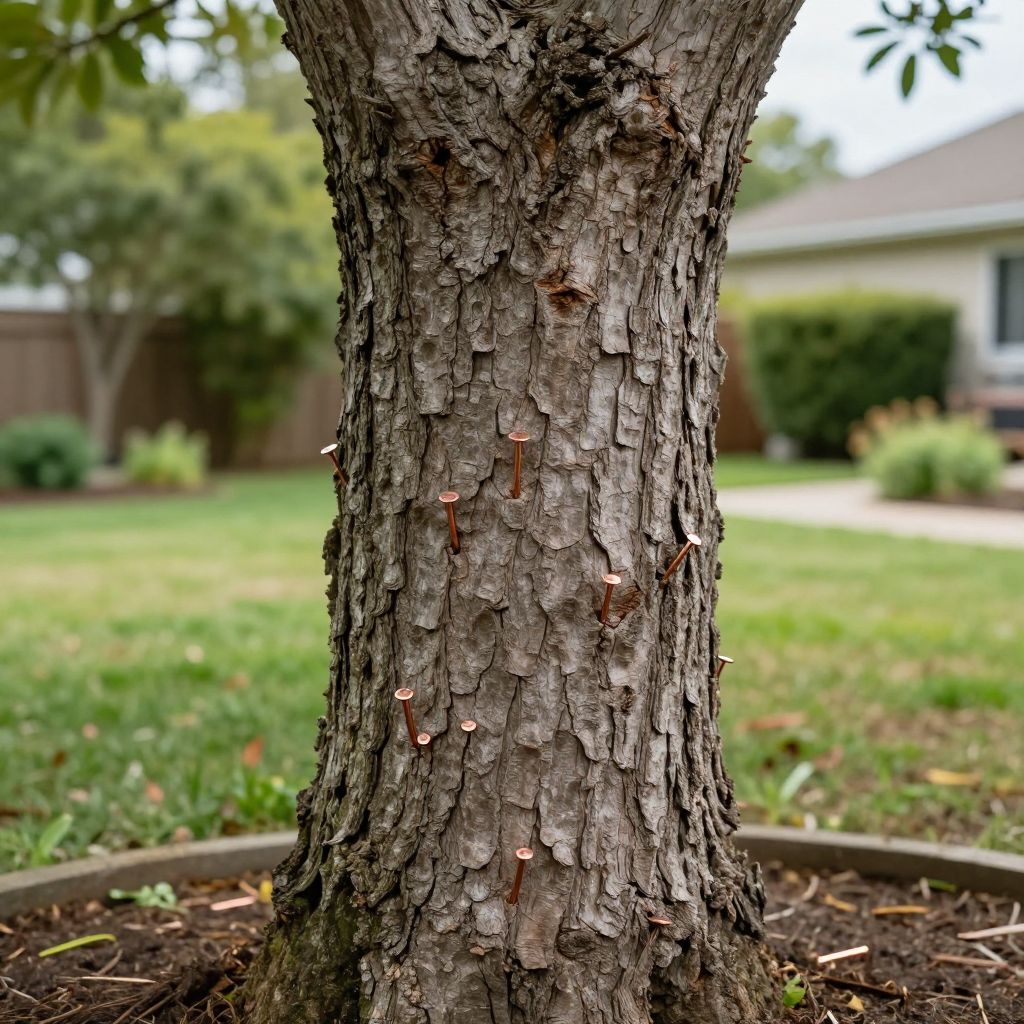
Do copper nails kill trees? It’s a common gardening question, especially when a stump, sapling, or unwanted tree is causing trouble. The short answer is that copper nails are not a reliable or humane way to kill a tree, and in many cases they do little more than wound the bark.
If you’re trying to remove a tree, there are safer and more effective methods than driving metal into the trunk. The best approach depends on the tree’s size, species, age, and whether you want to keep the roots, prevent regrowth, or simply remove a stump.
Do copper nails kill trees?
Usually, no. Copper nails do not consistently kill healthy trees. A tree may be damaged by repeated wounding, but a single nail or a few nails rarely deliver enough copper to kill it. In many cases, the tree compartmentalizes the injury and continues growing, while the main effect is bark damage and stress.
Why copper nails are not a dependable tree-killing method
The idea behind copper nails is that copper will poison the tree from the inside. In practice, that doesn’t work well for most trees because the amount of copper released is small and the tree’s vascular system does not absorb it evenly enough to cause a quick decline.
What actually happens when you hammer nails into a tree
- The bark and cambium are injured.
- The tree may form callus tissue around the wound.
- Some branches above the wound may weaken if the trunk is badly damaged.
- The tree may become more vulnerable to insects, fungi, and decay.
That means the tree may suffer, but not necessarily die. Worse, it can become unstable or diseased before it dies, which creates a safety risk in the landscape.
Will copper nails kill a tree stump or rooted sucker?
Not reliably. A stump or sucker can sometimes be weakened by repeated injury, but copper nails alone are not a dependable control method. If you need to stop regrowth from a stump or invasive suckers, cutting, digging, or using a stump-removal strategy is usually more effective.
Better options for stump and sucker control
- Cut suckers at the base as soon as they appear.
- Remove the stump by digging or grinding if practical.
- Keep the area mowed or mulched to spot regrowth early.
- Repeat cutting on persistent shoots to exhaust the root system over time.
Why wounding a tree is a bad shortcut
Even if the tree eventually declines, using nails can create avoidable problems. Wounds are entry points for decay organisms, and decay can spread inside the trunk long before the tree shows obvious symptoms.
Common risks of driving nails into trees
- Decay and rot in the trunk or major limbs
- Insect infestation attracted to weakened tissue
- Structural weakness that can lead to limb breakage
- Slow, uneven decline instead of clean removal
If the tree is near a house, fence, driveway, or walkway, this matters even more. A weakened tree can become a hazard before it dies completely.
What to do instead if you need to remove a tree
The right method depends on whether you’re dealing with a small sapling, a mature tree, or a stump. Start by identifying the tree’s size and how close it is to structures, utilities, and other plants.
For small saplings
- Cut the sapling as low to the ground as possible.
- Dig out the root crown if you can reach it.
- Watch for regrowth and remove new shoots promptly.
For larger trees
- Assess whether the tree can be safely removed in sections.
- Hire a certified arborist if the tree is large, leaning, diseased, or near hazards.
- Plan for stump removal or grinding after the trunk is down.
For stumps
- Stump grinding is often the fastest solution.
- Digging works for smaller stumps or shallow-rooted trees.
- Repeated cutting may work for suckering species if you can stay consistent.
If your goal is to stop a tree from growing back
Some trees resprout strongly from the stump or roots. In those cases, simply cutting once may not be enough. The key is to remove energy reserves over time or physically eliminate the stump and root crown.
Practical steps to reduce regrowth
- Cut regrowth as soon as it appears.
- Do not leave tall stumps, which often sprout more readily.
- Keep the area clear so you can spot new shoots early.
- Use mulch carefully; keep it away from the stump if you want to monitor sprouts.
Some species are naturally more persistent than others. If you’re unsure what tree you have, take photos of the leaves, bark, and sprouts and compare them with local extension resources or a nursery.
How to tell if a tree is already declining
If you’ve been told copper nails work, you may be looking at a tree that is already stressed. Before trying any removal method, check whether the tree is suffering from a separate problem such as drought, root damage, compaction, or disease.
Signs of stress or decline
- Thin canopy or sparse leaves
- Dead twigs at the ends of branches
- Cracked bark or oozing wounds
- Mushrooms or fungal growth near the base
- Premature leaf yellowing or drop
- Root flare buried too deeply by soil or mulch
These symptoms do not mean copper nails are a solution. They usually mean the tree needs diagnosis, improved care, or safe removal.
When a tree should be evaluated by an arborist
If the tree is large, valuable, or close to a structure, professional help is often the safest choice. A certified arborist can tell you whether the tree can be saved, pruned, cabled, or removed without creating a hazard.
Call a professional if the tree:
- Is leaning suddenly or shifting at the base
- Has major trunk damage
- Is near power lines or buildings
- Shows extensive decay or hollowing
- Needs removal in a tight space
Trying to “kill” a large tree with nails can leave you with a weakened tree that is still standing, which is often the worst outcome from a safety standpoint.
How to care for a tree you want to keep
If your real concern is that a tree is causing problems, the answer may be better care rather than damage. Trees often become troublesome when they are stressed by poor planting, compacted soil, drought, or improper pruning.
Basic care that helps trees stay healthy
- Water deeply during dry periods so moisture reaches the root zone.
- Mulch properly with a 2- to 4-inch layer, kept away from the trunk.
- Avoid soil compaction from foot traffic or heavy equipment near roots.
- Prune correctly to remove dead, damaged, or crossing branches.
- Inspect regularly for pests, disease, and root problems.
A healthy tree is less likely to fail, split, or become diseased. If a tree is simply in the wrong place, removal is still a better solution than trying to injure it slowly.
Common mistakes to avoid
Gardeners sometimes try quick fixes that create more work later. Avoid these common errors if you’re dealing with an unwanted tree or stump.
- Do not rely on copper nails as a guaranteed kill method.
- Do not wound a tree repeatedly if you are trying to keep it healthy.
- Do not ignore regrowth after cutting a tree down.
- Do not leave a hazardous tree standing if it has been badly damaged.
- Do not bury the trunk flare with soil or mulch, which can cause decline.
Bottom line: should you use copper nails?
Copper nails are not a dependable or recommended way to kill a tree. They may injure the trunk, but they usually do not solve the problem cleanly or safely. If you need to remove a tree, use proper cutting, stump grinding, or professional arborist help instead.
If you’re deciding what to do next, start by identifying the tree, checking its size and location, and choosing the safest removal or care method for your yard. For more practical tree guidance, look for reliable local extension or arborist resources on pruning, stump removal, and tree health.