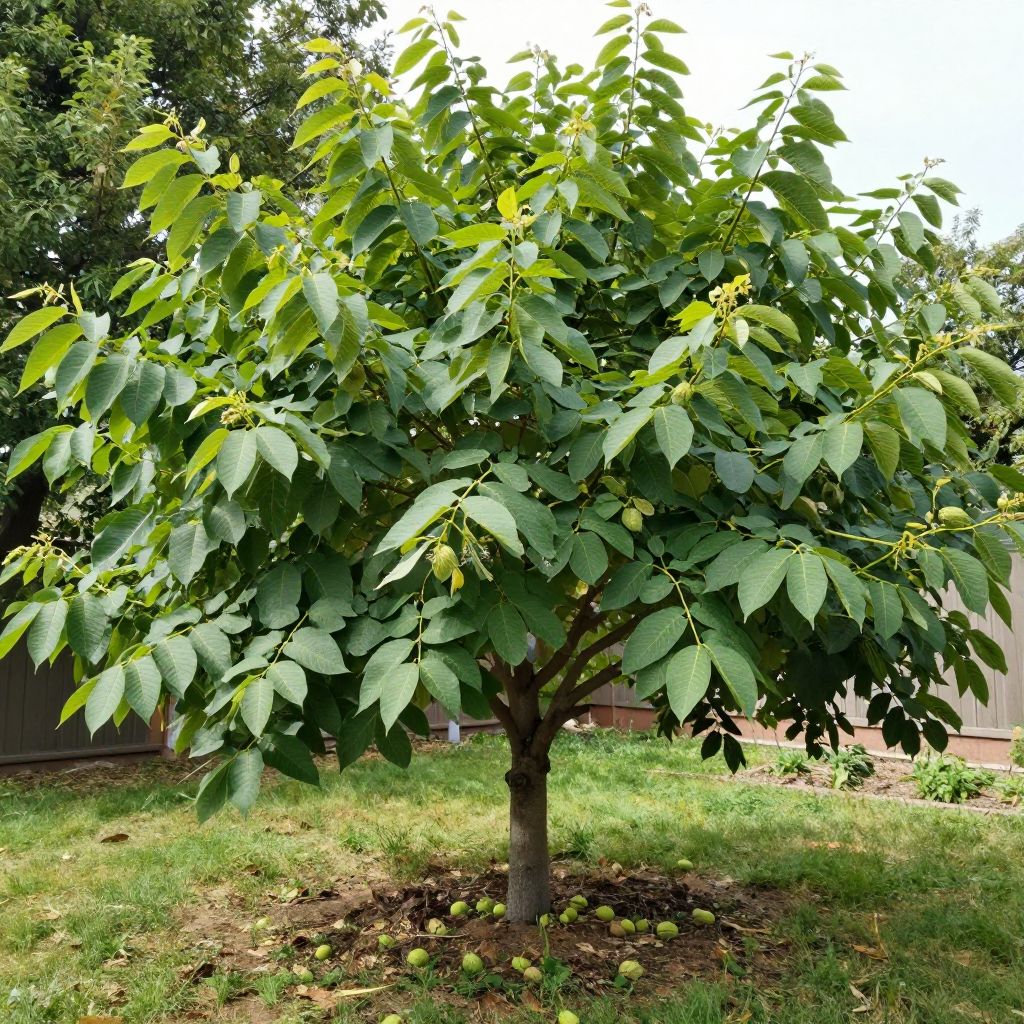
What does a walnut tree look like? If you’re trying to identify one in a yard, woodland edge, or young orchard, the answer depends a little on age and species, but walnut trees have a few reliable clues. Look for a tall, broad-canopied tree with pinnate leaves, thick furrowed bark as it matures, and round green husks that split to reveal the nut.
Walnuts are valuable landscape trees, but they also need room, sunlight, and well-drained soil to thrive. Once you know the key identification features, you can tell them apart from lookalike trees and decide whether one will suit your garden.
What does a walnut tree look like?
A walnut tree is usually a large deciduous tree with a straight trunk, an open rounded crown, and compound leaves made up of several leaflets. Mature bark becomes gray-brown and deeply ridged, while fruit develops inside a green husk that often falls in late summer or autumn.
Key identification features of walnut trees
Leaves
Walnut leaves are compound, meaning one leaf is made of multiple leaflets arranged along a central stem. Most walnut species have 5 to 23 leaflets per leaf, depending on the species and tree age.
- Leaf arrangement: Alternate along the twig, not opposite.
- Leaf shape: Oval to lance-shaped leaflets with pointed tips.
- Texture: Smooth to slightly rough, often aromatic when crushed.
- Color: Bright green in spring and summer, yellowing in autumn.
If you pick up a fallen leaf, the overall leaf can be quite long, sometimes 12 to 24 inches or more on mature trees. That length is one of the easiest clues when you’re standing under a walnut in summer.
Bark
Young walnut trees have smoother bark, but as they age, the bark becomes gray to dark brown and develops deep vertical furrows. On older trees, the ridges can look rough and blocky.
This bark pattern helps separate walnuts from some other broadleaf trees, but remember that young walnuts may not yet show the classic deeply ridged look. For young trees, leaves and twigs are often more useful for identification.
Twigs and buds
Walnut twigs are sturdy and usually light brown to olive-brown. The pith inside the twig is chambered or solid depending on species, and the terminal bud is often larger than the side buds.
In winter, walnut buds can help with identification, but they are easiest to use if you already know what the tree’s leaves and fruit look like in the growing season.
Flowers and fruit
Walnuts are wind-pollinated and produce separate male and female flowers on the same tree. The male flowers appear as long hanging catkins, while the female flowers are small and less noticeable.
The fruit is the best giveaway later in the season. A walnut develops inside a green outer husk that usually splits when ripe, revealing the hard shell beneath.
- Green husk: Smooth or slightly sticky outer covering around the nut.
- Shell: Hard, brown, and ridged or smooth depending on species.
- Nut drop: Often occurs in late summer to fall.
Common walnut species you may see
English walnut (Juglans regia)
English walnut is often grown for nuts. It usually has a more open crown, smoother bark when young, and leaflets that are somewhat broader and fewer in number than black walnut. The nuts are commonly easier to crack and eat.
Black walnut (Juglans nigra)
Black walnut is a native North American tree known for its strong wood and flavorful nuts. It often has darker bark, more leaflets per leaf, and a stronger aroma from the leaves and husks.
Black walnut is especially important in gardening because it produces juglone, a natural compound that can affect some nearby plants. If you are planting near one, this matters a lot.
Butternut (Juglans cinerea)
Butternut is another walnut relative with elongated, sticky, hairy-looking fruit and softer bark than black walnut. It is less common in many areas and can be confused with other walnut species if you only look quickly.
How to tell walnut trees apart from lookalikes
Several trees can resemble walnut at first glance, especially when they are young. The easiest way to avoid confusion is to check the leaf structure, fruit, and bark together rather than relying on one feature alone.
- Hickory: Also has compound leaves, but the leaflets and bark pattern differ, and hickory nuts have a different husk and shell structure.
- Ash: Has opposite branching and compound leaves, but ash does not produce walnut-like husked fruit.
- Tree-of-heaven: Has compound leaves, but the leaflets are usually more numerous and the plant has a different smell and growth habit.
- Sumac: Often smaller, shrubby, and produces fuzzy upright fruit clusters rather than walnut husks.
Best rule: if the tree has alternate branching, compound leaves, and round green husked fruit, walnut is a strong possibility.
Growing conditions walnut trees prefer
Walnut trees are not small ornamental trees. They need space, full sun, and soil that drains well. If you are considering planting one, think long term: these trees can become large and wide-spreading.
Sunlight
Walnuts grow best in full sun. In shade, they become weaker, less productive, and more prone to disease. For the healthiest tree, choose a site that gets most of the day in direct light.
Soil
Walnuts prefer deep, fertile soil with good drainage. They tolerate a range of soil types, but waterlogged ground can lead to root problems and poor growth.
If your soil is heavy clay, improve drainage before planting by choosing a better site or creating a raised planting area. Do not plant a walnut where water stands after rain.
Space
Give walnut trees plenty of room away from buildings, driveways, and overhead wires. Mature trees can spread widely, and their roots and canopy need space to develop naturally.
- Allow generous spacing from other trees and shrubs.
- Avoid planting too close to patios or foundations.
- Plan for shade cast by the mature canopy.
Planting and early care
If you are planting a walnut tree, the first few years are about root establishment. A young tree that is planted correctly will usually adapt better than one that is rushed into poor soil or a cramped site.
- Choose a sunny, well-drained location with room to grow.
- Dig a hole as deep as the root ball and wider than the roots.
- Set the tree so the root flare sits at or slightly above soil level.
- Backfill with native soil unless your soil is extremely poor.
- Water thoroughly to settle the soil around the roots.
- Apply mulch in a wide ring, keeping it a few inches away from the trunk.
Do not bury the trunk flare. Planting too deep is a common mistake that can weaken a walnut tree over time.
Watering young trees
Newly planted walnuts need consistent moisture while they establish, but they should never sit in soggy soil. Check the soil by hand rather than following a rigid schedule, because weather, soil type, and tree size all affect watering needs.
A good rule is to water deeply when the top few inches of soil begin to dry. Mature trees are more drought-tolerant, but they still benefit from watering during prolonged dry spells, especially in sandy soils.
Mulching
Mulch helps conserve moisture, moderate soil temperature, and reduce weeds. Use an organic mulch such as wood chips or shredded bark in a broad ring under the canopy, but keep it pulled back from the trunk.
- Apply mulch 2 to 4 inches deep.
- Keep mulch off the bark to prevent rot.
- Refresh as needed as it breaks down.
Pruning walnut trees
Walnuts usually need only light pruning when young, mainly to remove damaged, crossing, or poorly placed branches. Because they can bleed sap if pruned at the wrong time, careful timing matters.
In general, avoid heavy pruning during active spring growth. If pruning is needed, remove only what is necessary and use clean, sharp tools.
Pruning tips
- Remove dead, broken, or rubbing branches first.
- Keep the central structure balanced.
- Do not remove too much canopy at once.
- Disinfect tools if you are cutting diseased wood.
If you are unsure about a large or mature tree, it is safer to consult a certified arborist than to make major cuts yourself.
Common pests and diseases
Walnut trees can be affected by insects and fungal or bacterial problems, especially if they are stressed by poor drainage, crowding, or drought. Healthy site conditions are one of the best defenses.
Common issues to watch for
- Walnut anthracnose: Causes leaf spotting and early leaf drop in wet seasons.
- Blights and cankers: May damage shoots, leaves, or branches.
- Walnut husk fly: Can affect the husks and reduce nut quality.
- Aphids and scale insects: May weaken young growth.
For most home gardeners, the best first response is sanitation and observation: remove fallen infected leaves if practical, prune out damaged branches, and avoid overwatering. If a serious disease is spreading, get a local diagnosis before treating.
Juglone and planting near walnut trees
Black walnut and some related species release juglone, a natural chemical that can suppress sensitive plants. This is one of the most important gardening facts to know before planting near a walnut tree.
Symptoms in sensitive plants can include yellowing, wilting, stunting, or sudden decline. The effect is strongest under and near the tree’s root zone, though the exact distance varies with soil and tree size.
What to do if you garden near a walnut
- Choose juglone-tolerant plants when possible.
- Keep vegetable beds away from the root zone if you have black walnut nearby.
- Use compost carefully and only if you know walnut debris has fully broken down.
- Watch new plantings closely for stress during the first season.
If you are not sure whether a tree is black walnut or another species, identification matters before you place sensitive ornamentals or vegetables nearby.
Harvesting walnuts
When walnuts are grown for nuts, harvest timing depends on the species and your climate, but ripe nuts usually begin to fall when the husks split or loosen. Gather fallen nuts promptly so they do not mold or become damaged by pests.
After collection, remove the husk if it has not already split, then dry the nuts in a cool, airy place. Proper drying improves storage and shell quality.
- Pick up nuts regularly during drop season.
- Wear gloves if husks stain your hands.
- Dry nuts thoroughly before storage.
When a walnut tree is a good choice for your garden
A walnut tree is a good choice if you have plenty of space, full sun, and soil that drains well. It is less suitable for small yards, tight urban lots, or mixed planting beds filled with sensitive species.
Before planting, think about the tree’s mature size, nut drop, shade, and possible juglone effects. A walnut can be a beautiful long-term landscape tree, but only if the site matches its needs.
Conclusion
If you are asking what a walnut tree looks like, start by checking for compound leaves, alternate branching, furrowed bark, and green husked fruit. Those features, taken together, usually point you in the right direction. If you want, compare the tree’s leaves and fruit with a known walnut species before planting anything nearby.
For more help identifying trees in the garden, you may also find this guide useful: what type of tree is this?