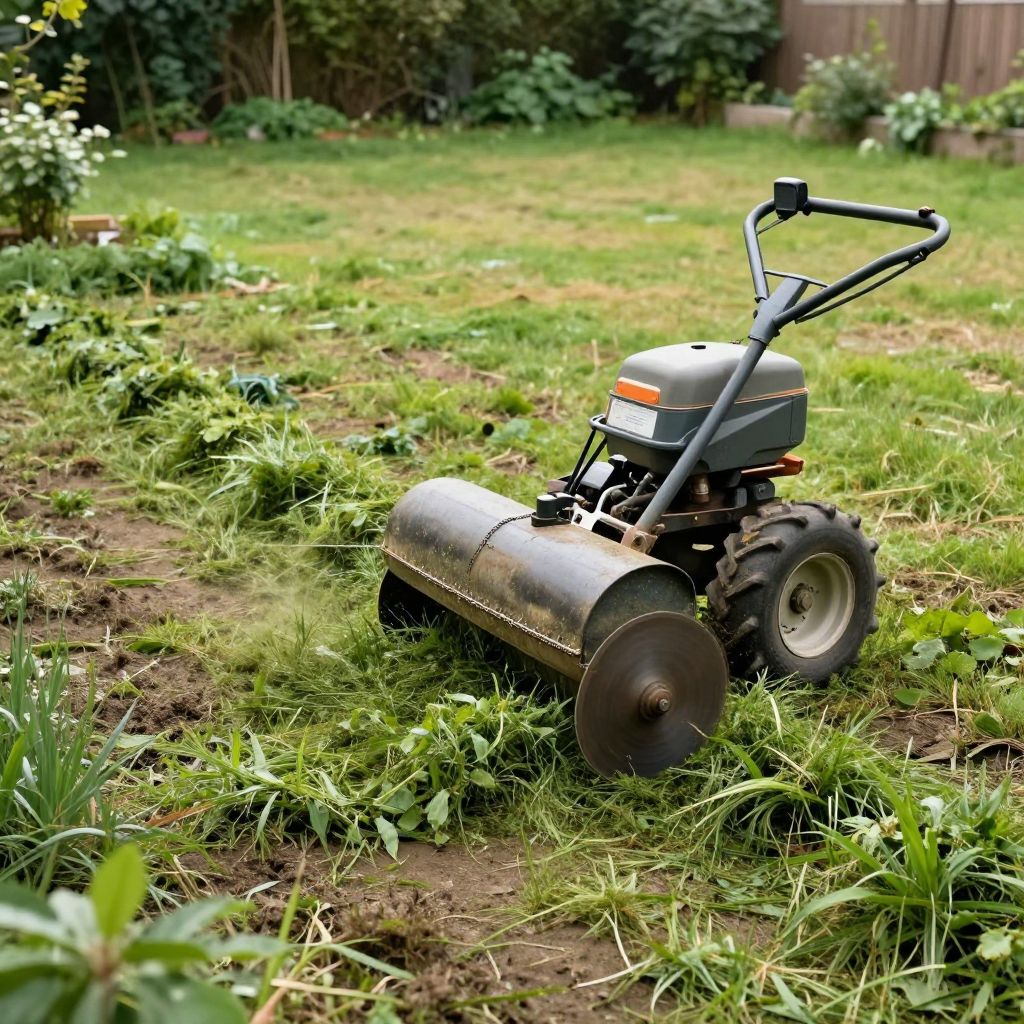
If you’re asking what is a flail mower, you’re probably trying to identify a machine that can tame rough grass, weeds, and light brush without leaving a neat, striped lawn finish. A flail mower is a heavy-duty cutting tool used on overgrown ground, slopes, orchards, field edges, and rough landscaping areas.
It works differently from a rotary mower: instead of one spinning blade, it uses many small blades or “flails” mounted on a rotating drum. That design makes it useful where debris, uneven ground, and tougher vegetation are common.
What is a flail mower?
A flail mower is a mower with a horizontal rotor fitted with many hinged or fixed cutting flails that spin at high speed to chop vegetation into fine pieces. It is commonly used for rough grass, brambles, weeds, roadside growth, orchards, and other uneven areas where a standard lawn mower would struggle or be damaged.
How a flail mower works
The cutting drum rotates inside a protective housing. As the machine moves forward, the flails strike and shred plants repeatedly rather than slicing them once.
This repeated chopping is why flail mowers handle dense growth better than many consumer mowers. It also helps reduce the chance of throwing large objects far from the machine, though you should still clear the area first.
Key parts to recognize
- Rotor or drum — the spinning shaft that holds the flails.
- Flails — the cutting pieces, often Y-shaped, hammer-shaped, or blade-like.
- Housing — the metal cover around the rotor that contains debris.
- Rear roller or skids — helps control cutting height and finish.
- Drive system — powered by a tractor PTO, hydraulic motor, or engine, depending on the model.
How to identify a flail mower in the garden or landscape
If you are looking at equipment and wondering whether it is a flail mower, check for a long cylindrical rotor hidden inside a steel deck and a row of many small cutting pieces instead of one or two large blades. The machine usually leaves a more mulched, textured finish than a rotary mower.
Common visual clues
- Many small cutting elements rather than one large blade.
- A boxy or enclosed cutting deck.
- Rear roller for leveling and height control.
- Often mounted to a tractor, compact utility vehicle, or tow-behind frame.
- Designed for rough vegetation, not just turf grass.
When a flail mower is the right choice
Use a flail mower when your ground is too rough, thick, or unpredictable for a standard lawn mower. It is especially useful for neglected lots, field margins, orchard alleys, ditch banks, and areas with sticks or light woody growth.
For fine ornamental lawns, a flail mower is usually not the best choice because it is built for durability and rough cutting, not a pristine golf-course finish.
Good uses in a garden or landscape
- Overgrown grass and weeds.
- Uneven ground where a rotary mower may scalp.
- Orchard floor management between rows.
- Brushy edges and fence lines.
- Large properties where debris is common.
Flail mower vs. rotary mower
Both machines cut vegetation, but they do it differently. A rotary mower uses one or two fast-spinning blades, while a flail mower uses many small flails that repeatedly strike the plant material.
- Flail mower: better for rough, dense, or debris-prone areas; usually safer around flying objects; finer mulching action.
- Rotary mower: better for open, relatively even grass; often faster for simple lawn maintenance; can leave a cleaner-looking cut on turf.
If your priority is handling tough growth with less risk of thrown debris, a flail mower is often the better fit. If your priority is a smooth lawn finish, a rotary mower may be more suitable.
How to use a flail mower safely and effectively
Because flail mowers are powerful and can hide hazards in tall growth, preparation matters. Always inspect the area first and start with a conservative cutting height.
Step-by-step mowing approach
- Clear the area of stones, wire, branches, toys, and other hard debris.
- Check the ground for holes, stumps, irrigation heads, and hidden obstacles.
- Set a higher cutting height for the first pass if the area is heavily overgrown.
- Move slowly through dense material so the flails can process it evenly.
- Overlap passes slightly to avoid missed strips.
- Make a second pass if needed after the first cut has lowered the growth.
Safety basics
- Keep people and pets well away from the work area.
- Wear eye protection, sturdy shoes, and hearing protection.
- Do not operate on steep slopes unless the machine is designed for that use and you are trained to handle it.
- Stop and inspect if you hit a rock, wire, or other hard object.
Cutting height, season, and plant conditions
There is no single correct cutting height for every job. The right setting depends on plant height, density, moisture, and how rough the ground is. In general, start higher in thick or unknown growth and lower it gradually after the first pass.
Season matters too. Wet spring growth can clog more easily, while dry summer weeds may cut more cleanly. Avoid mowing when vegetation is soaked if you can, because wet material can clump and reduce cutting quality.
How to adapt to local conditions
- Dense growth: take two passes rather than forcing one low cut.
- Uneven ground: raise the deck or use skids/roller settings that reduce scalping.
- Dry, brittle weeds: mow more slowly to reduce dust and missed stems.
- Wet vegetation: wait for better conditions if possible to avoid clogging.
Maintenance and care for a flail mower
Good maintenance keeps the machine cutting cleanly and helps prevent vibration, uneven cutting, and premature wear. Because flails strike debris repeatedly, they can loosen, dull, or wear out faster than blades on a typical lawn mower.
Routine maintenance checklist
- Inspect flails for cracks, bends, or uneven wear.
- Check fasteners and mounting hardware regularly.
- Clean packed grass and debris from the housing after use.
- Lubricate moving parts according to the manufacturer’s instructions.
- Watch for unusual vibration, which can signal imbalance or damage.
If the cut begins to look ragged, the flails may be worn or the rotor may need service. Do not keep running a damaged machine, because imbalance can worsen quickly.
Common problems and troubleshooting
Most flail mower issues come from worn parts, incorrect cutting height, or trying to cut vegetation that is too tall or too wet for the current setup.
Problem: uneven cut
This can happen if the deck is set too low, the ground is uneven, or the flails are worn unevenly. Raise the cutting height, slow down, and inspect the flails for damage.
Problem: clogging or poor discharge
Wet grass, thick weeds, and slow rotor speed can all contribute. Let the area dry if possible and avoid forcing the mower through heavy material in one pass.
Problem: excessive vibration
Vibration often points to a bent flail, missing hardware, or an unbalanced rotor. Stop using the machine and inspect it before continuing.
Problem: poor performance in brush
A flail mower can handle light brush, but it is not a forestry mulcher. If stems are too thick or woody, you may need a more specialized machine or to cut the growth back in stages.
What a flail mower is not
A flail mower is not a lawn finish mower, and it is not meant to replace every cutting tool in the landscape. It is a practical rough-cutting machine for managing vegetation that would overwhelm a standard mower.
It is also not the best tool for delicate beds, tight ornamental spaces, or areas where you need a very manicured appearance.
Choosing the right mower for your property
If you are deciding whether a flail mower makes sense, start by looking at the type of growth you have, the roughness of the ground, and how often you need to cut it. The more uneven and overgrown the area, the more useful a flail mower becomes.
- Choose a flail mower for rough, mixed, and debris-prone areas.
- Choose a rotary mower for simpler lawn maintenance.
- Choose a string trimmer or brush cutter for edges and tight spots.
For many properties, the best approach is a combination of tools rather than one machine for everything.
Conclusion
A flail mower is a rugged, versatile mower designed to cut rough vegetation safely and efficiently. If you need to manage overgrown grass, weeds, or light brush, identify the machine by its many small flails, enclosed drum, and heavy-duty build, then use it with a careful first pass and regular maintenance.
If you are comparing equipment for your property, you may also find it helpful to read about what kind of oil a lawn mower takes before servicing your other garden machinery.