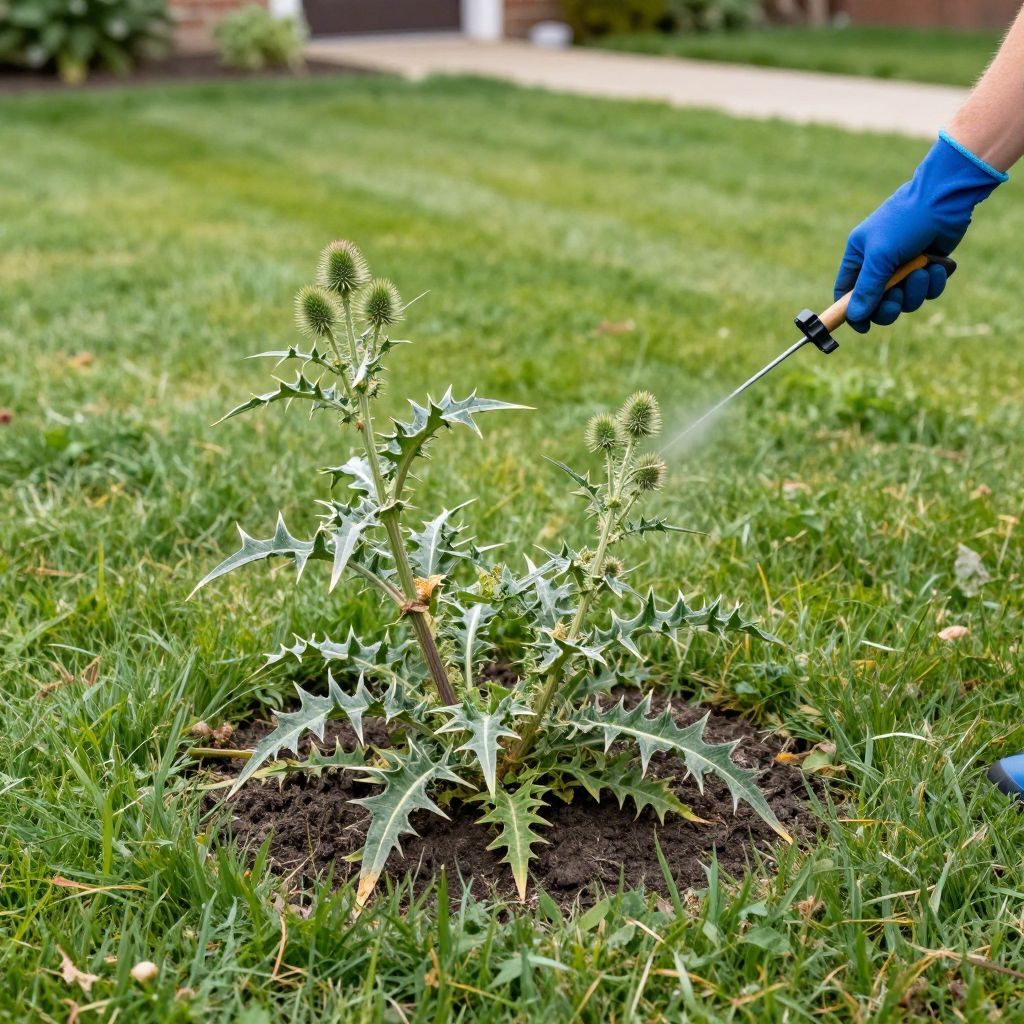
What kills thistles but not grass? The short answer is a selective broadleaf weed killer, used carefully and at the right time, because thistles are broadleaf plants while turfgrass is a grass. You can also control them without herbicide by digging out the roots, mowing repeatedly, and improving the lawn so thistles have less room to return.
The best method depends on the type of thistle, how large the patch is, and whether you want a chemical or non-chemical approach. The key is to hit thistles when they are actively growing and before they set seed, while protecting desirable grass and nearby ornamentals.
What kills thistles but not grass?
Selective broadleaf herbicides are the most common answer. Products containing active ingredients such as 2,4-D, dicamba, MCPP, or triclopyr are designed to kill broadleaf weeds like thistles while leaving most lawn grasses unharmed when used exactly as directed. For small infestations, repeated digging and mowing can also work.
Why thistles are so hard to remove
Thistles are persistent because many species grow from a deep taproot and can regrow from root fragments. Some also spread by seed, so a single mature plant can create a bigger problem next season.
Common thistle types in lawns and gardens
- Canada thistle (Cirsium arvense) — spreads by creeping roots and often forms patches.
- Bull thistle (Cirsium vulgare) — usually a biennial with a spiny rosette first, then a tall flowering stalk.
- Other prickly thistles — many behave similarly and are controlled with the same general methods.
Knowing whether you are dealing with a rosette, a patch of runners, or a flowering stalk helps you choose the right control method and timing.
Best selective herbicides for thistles in grass
If you want to keep grass and remove thistles, look for a lawn weed killer labeled for broadleaf weeds in turf. These products are formulated to target weeds with broad leaves, not grasses. Always read the label carefully, because not every product is safe for every lawn type.
What to look for on the label
- Broadleaf weed control for lawns
- Thistle listed among the controlled weeds
- Compatibility with your turf species
- Clear instructions for spot treatment or broadcast application
Important: Never assume a weed killer is safe for all lawns. Some turfgrasses, especially newly seeded lawns or certain warm-season grasses, can be sensitive to some herbicides.
When herbicide works best
- When thistles are young rosettes or actively growing
- On a calm, dry day to reduce drift
- When rain is not expected soon, if the label says it needs time to dry
- When the lawn is not under drought stress
Late summer to early fall is often a strong window for perennial thistles, because plants move energy into their roots. In spring, treat young growth before flowering if possible.
How to apply broadleaf weed killer safely
Spot-treating thistles is usually better than spraying the whole lawn. That reduces risk to nearby flowers, shrubs, vegetables, and other broadleaf plants.
- Identify the thistle and confirm it is in turfgrass, not in a flower bed or vegetable patch.
- Choose a product labeled for your lawn type and the weed you want to control.
- Apply only as directed, using the labeled rate and method.
- Avoid windy conditions so spray does not drift onto desirable plants.
- Keep children and pets off the area until the product label says it is safe.
- Check the patch again in 2 to 3 weeks and retreat only if the label allows it.
If the thistle is large and mature, one treatment may not be enough. Deep-rooted plants often need follow-up control.
Mistakes to avoid with herbicides
- Spraying on a hot, windy day
- Using a product not labeled for your grass type
- Applying too late after the thistle has already seeded
- Spraying stressed, drought-stricken turf
- Overlapping applications and exceeding label directions
Non-chemical ways to kill thistles without harming grass
If you prefer not to use herbicides, you can still reduce thistles in a lawn. The tradeoff is that it usually takes more time and repeated effort, especially for perennial species with deep roots.
Dig out the root
For isolated plants, use a sharp weeding knife, dandelion fork, or narrow spade to remove as much of the root as possible. Work after rain or irrigation when the soil is moist, because roots come out more cleanly.
- Loosen the soil around the plant first.
- Lift the crown and taproot as deeply as you can.
- Remove any broken pieces left behind if possible.
- Dispose of seed heads carefully so they do not spread.
This method works best on small, young thistles. Large established plants may regrow if the root is not removed well.
Mow before seed heads form
Frequent mowing does not usually kill a mature thistle immediately, but it can stop seed production and weaken the plant over time. Do not let thistles flower and set seed if you can avoid it.
- Mow regularly at the recommended height for your grass.
- Bag clippings if seed heads are present.
- Repeat mowing whenever new stalks appear.
Tip: Cutting one flowering stem is not enough if the plant keeps producing new stems from the crown or roots.
Smother small patches in non-lawn areas
In paths, vacant ground, or unused beds, you can smother thistles with cardboard, mulch, or black landscape fabric. This is not practical in an active lawn, but it can help in neglected edges where thistles often start.
How to make your lawn less inviting to thistles
Healthy, dense turf is one of the best long-term defenses. Thistles usually move into thin, compacted, or underfed lawns where grass has trouble filling in bare spots.
Improve turf competition
- Overseed thin areas with a grass type suited to your climate.
- Mow at the correct height for your lawn species; taller grass shades weed seedlings.
- Water deeply but not too often, so grass roots grow stronger.
- Aerate compacted soil if water runs off or roots struggle.
- Fill bare spots promptly so thistles do not colonize open soil.
Good lawn care does not remove existing thistles instantly, but it makes future infestations much less likely.
Soil and drainage matter
Thistles often take advantage of stressed turf, but they can also appear in compacted or poorly drained soil. If water pools after rain, or if the ground is hard and crusted, grass may thin out and weeds may move in.
Before adding fertilizer or more seed, check whether the real problem is compaction, poor drainage, or low soil fertility. Fixing the underlying issue usually improves weed control more than repeated spraying alone.
What to do by season
Timing matters because thistles respond differently through the year. The best control is usually when plants are actively growing and before they make seed.
Spring
- Spot-treat young rosettes in turf if the label allows spring use.
- Dig out small plants after rain when soil is softer.
- Begin mowing before stalks elongate.
Summer
- Keep mowing to prevent flowering.
- Watch for seed heads and remove them immediately.
- Avoid herbicide drift onto heat-stressed grass.
Fall
- Treat perennial thistles while they are moving energy into roots.
- Overseed thin turf areas after control, if your climate and grass type allow it.
- Mulch or cover bare soil in non-lawn areas.
How to tell if the treatment worked
After treatment, thistle leaves should yellow, curl, or collapse over time, but the exact response depends on the product and weather. Some plants die back quickly, while others take longer to show clear decline.
- Check for new growth from the crown after 2 to 3 weeks.
- Look for missed side shoots or nearby seedlings.
- Re-treat only if the product label permits it.
- Keep monitoring the area for new seedlings from old seed banks.
If the plant is still green and vigorous after treatment, it may need a second pass or a different control method. Do not rush to reapply unless the label says it is safe.
Common problems and practical fixes
Thistles keep coming back
This usually means the root system was not fully controlled or new seeds are germinating. Combine spot treatment, mowing, and lawn thickening for better long-term results.
Grass turns yellow after spraying
You may have used the wrong product, applied too much, or sprayed during heat stress. Water the lawn as needed, avoid repeat applications, and confirm the product is labeled for your grass type.
Thistles are in a flower bed, not the lawn
Do not use a lawn herbicide near desirable broadleaf plants. Instead, dig out the plant, cut it before seed set, or use a carefully targeted method approved for beds and ornamentals.
Simple plan for most home gardeners
If you want the most practical answer to what kills thistles but not grass, start with a selective broadleaf herbicide labeled for your lawn. For a smaller, chemical-free approach, dig out young plants, mow before flowering, and thicken the turf so thistles lose their foothold.
For more help with lawn weeds and turf care, you may also want to read how to improve thin grass patches and practical tips for identifying common lawn weeds.