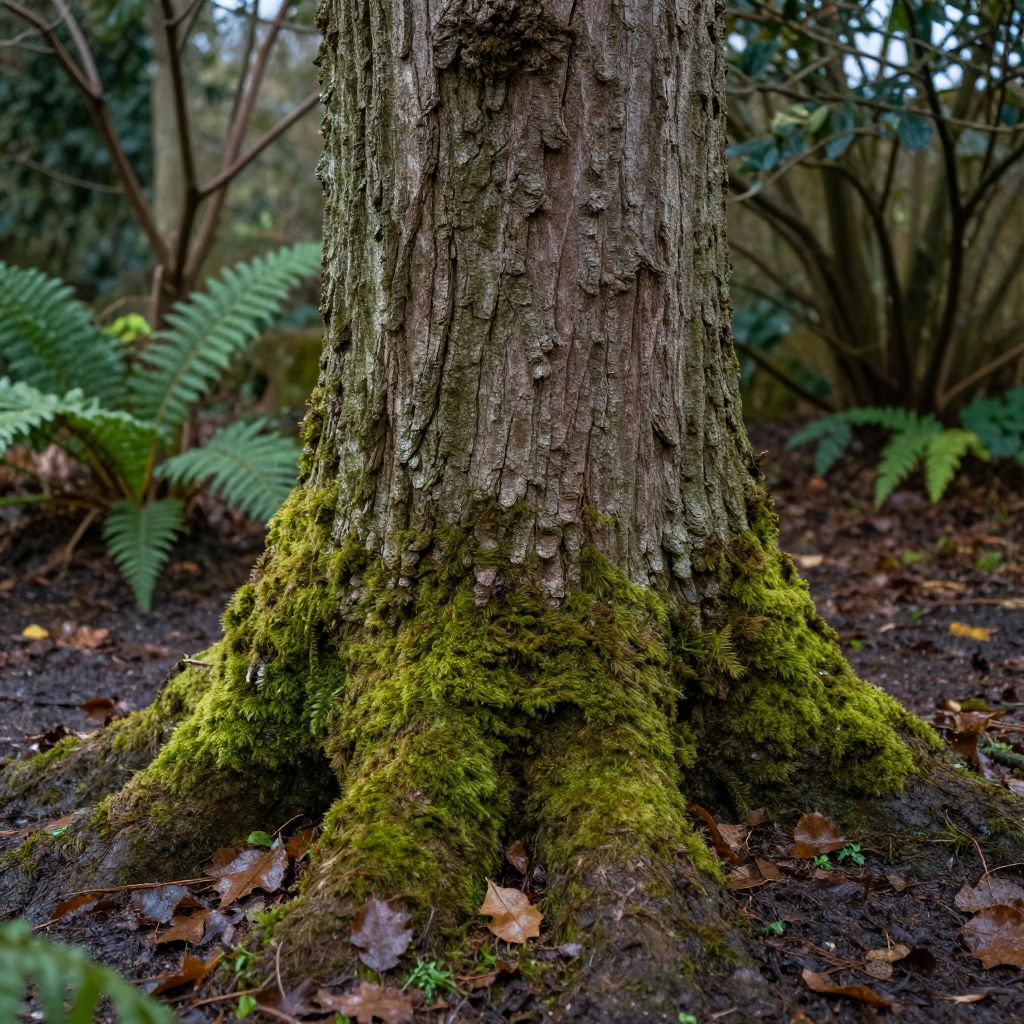
What side of a tree does moss grow on? The short answer is: often the shadier, damper side, but not always. Moss grows where conditions suit it best—usually on bark that stays moist longer, receives less direct sun, and is sheltered from drying wind.
If you want to read moss as a garden clue, look at the whole site, not just the tree. Light, humidity, bark texture, rainfall, and nearby structures all affect where moss appears, so the “north side” rule is only a rough guideline in many places.
What side of a tree does moss grow on?
Moss most often grows on the side of a tree that stays coolest and dampest, which is frequently the north side in the Northern Hemisphere. But this is not a reliable compass test. Moss can grow on any side if that side is shaded, humid, and slow to dry, especially on rough bark and in sheltered gardens.
Why moss chooses one side over another
Mosses are non-vascular plants, so they absorb moisture directly from the air and rain. They do best where water lingers on the bark and sunlight does not dry the surface too quickly.
Common conditions that favor moss growth
- Shade or filtered light from buildings, fences, evergreen trees, or dense canopies.
- Higher humidity after rain, near ponds, in foggy climates, or in sheltered courtyards.
- Rough bark that gives moss a place to anchor.
- Slow drying from poor air movement or protection from wind.
- Older bark that is stable and textured rather than smooth and shedding.
In dry, sunny, or windy gardens, moss may be sparse on all sides of a tree. In cool, wet climates, it may cover much of the trunk and branches, not just one side.
Is moss on a tree a problem?
Usually, no. Moss on healthy tree bark is generally harmless and does not feed on the tree. It uses the bark as a surface to live on, not as a parasite. The real issue is often the growing environment around the tree, not the moss itself.
That said, heavy moss can sometimes indicate that the tree is in a damp, shaded location with limited airflow. If the tree also has poor vigor, cracking bark, or lots of lichen, it is worth checking the site and the tree’s overall health.
When to pay closer attention
- The trunk stays wet for long periods after rain.
- The tree has peeling bark, dieback, or sparse foliage.
- Moss is thickest on a side that also has damage or decay.
- The base of the tree is mulched too deeply or buried in soil.
How to tell if moss is helping or just marking a wet site
Moss itself is usually not harmful, but it can be a useful signpost. If moss is growing heavily on one side, that side is probably receiving less sun and drying more slowly. That matters if you are trying to diagnose drainage, airflow, or light conditions in the garden.
Use moss as a site clue
- Look at where the moss is thickest on the trunk and lower branches.
- Check for nearby shade from buildings, hedges, or other trees.
- Notice whether the area stays damp after rain or irrigation.
- Inspect the soil around the root zone for compaction or poor drainage.
- Compare the moss pattern with wind exposure and afternoon sun.
If moss is concentrated on one side, that side may be the coolest, dampest, or most sheltered part of the tree. If moss is evenly spread, the whole site may be humid and shaded.
How to encourage moss on trees or in the garden
If you like the look of moss, you can encourage it by creating the right conditions. Moss is best treated as a natural feature of a woodland-style garden, not as a plant you can force into a hot, dry border.
Practical ways to support moss growth
- Choose a shaded or partially shaded area.
- Keep the site consistently moist, but not waterlogged.
- Reduce strong afternoon sun and drying wind where possible.
- Avoid harsh bark scrubbing or pressure washing.
- Minimize disturbance to the bark surface and nearby soil.
For a moss-friendly garden, think woodland floor rather than dry lawn. Moss often establishes more easily on stones, logs, retaining walls, and old bark than on exposed trunks in full sun.
What not to do
- Do not apply fertilizer to “feed” moss; moss does not benefit from typical lawn feeding.
- Do not overwater the tree’s root zone just to make moss appear.
- Do not seal bark with paint or coatings unless directed by a qualified arborist for a specific problem.
- Do not scrape away moss aggressively if the bark is already thin or damaged.
If you want to remove moss from a tree
Sometimes gardeners want to remove moss for appearance or to inspect bark more clearly. Light moss usually comes off easily, but you should avoid damaging the tree in the process.
Safer removal approach
- Wait for dry weather so the bark is less fragile.
- Use a soft brush or your gloved hand to lift loose moss gently.
- Work slowly and stop if the bark starts to flake or tear.
- Improve the site conditions if moss returns quickly.
Do not use wire brushes, knives, or high-pressure water on tree bark. Those methods can wound the tree and create entry points for pests and disease.
What moss growth can tell you about tree care
Moss does not usually mean a tree is unhealthy, but it can point to conditions that may need adjustment. If the tree is in a dense, shady corner, you may need better airflow, more light, or improved drainage nearby.
Tree care checks worth making
- Soil drainage: Water should soak in without leaving the area soggy for long periods.
- Mulch depth: Keep mulch away from direct contact with the trunk and avoid piling it high.
- Canopy balance: Remove dead or crossing branches when appropriate to improve light and airflow.
- Root competition: Dense groundcover or nearby hardscape can affect moisture patterns.
If you are unsure whether the tree is stressed, look for other signs such as sparse leaves, dead twigs, fungal growth at the base, or bark splitting. Moss alone is not a diagnosis.
Seasonal and regional differences
The old “moss grows on the north side” idea comes from places in the Northern Hemisphere where north-facing surfaces often receive less direct sun. Even there, it is only a general pattern. Local climate matters more than a compass reading.
Why the rule changes by location
- In humid coastal regions, moss may grow on many sides of a tree.
- In dry inland gardens, it may be limited to deeply shaded spots.
- In the Southern Hemisphere, the cooler side is often the south side, not the north.
- Nearby walls, slopes, and buildings can override compass direction entirely.
So if you are using moss to orient yourself in the garden, treat it as a clue, not a compass. Shade and moisture patterns are more dependable than direction alone.
Common mistakes gardeners make
Gardeners often assume moss means a tree is unhealthy, or that every moss patch points the same way. In reality, moss responds to microclimates, and those can vary from one trunk to the next.
- Assuming all moss means north: It may simply mean shade.
- Overwatering to encourage moss: This can stress roots and invite other problems.
- Scrubbing bark too hard: This can damage the tree.
- Ignoring site conditions: Poor drainage and low airflow often matter more than the moss itself.
- Confusing moss with lichen: They are different organisms and behave differently on bark.
Simple takeaway for home gardeners
If you are asking what side of a tree moss grows on, the best answer is: usually the shadier, damper side, but not always the north side. Moss follows moisture and light conditions, so use it as a clue about your garden’s microclimate rather than a strict rule.
Next time you notice moss on a trunk, take a few minutes to check shade, airflow, and drainage around the tree. If you want to learn more about tree health and site conditions, look for related gardening reading on bark care, pruning, and improving drainage in shaded areas.