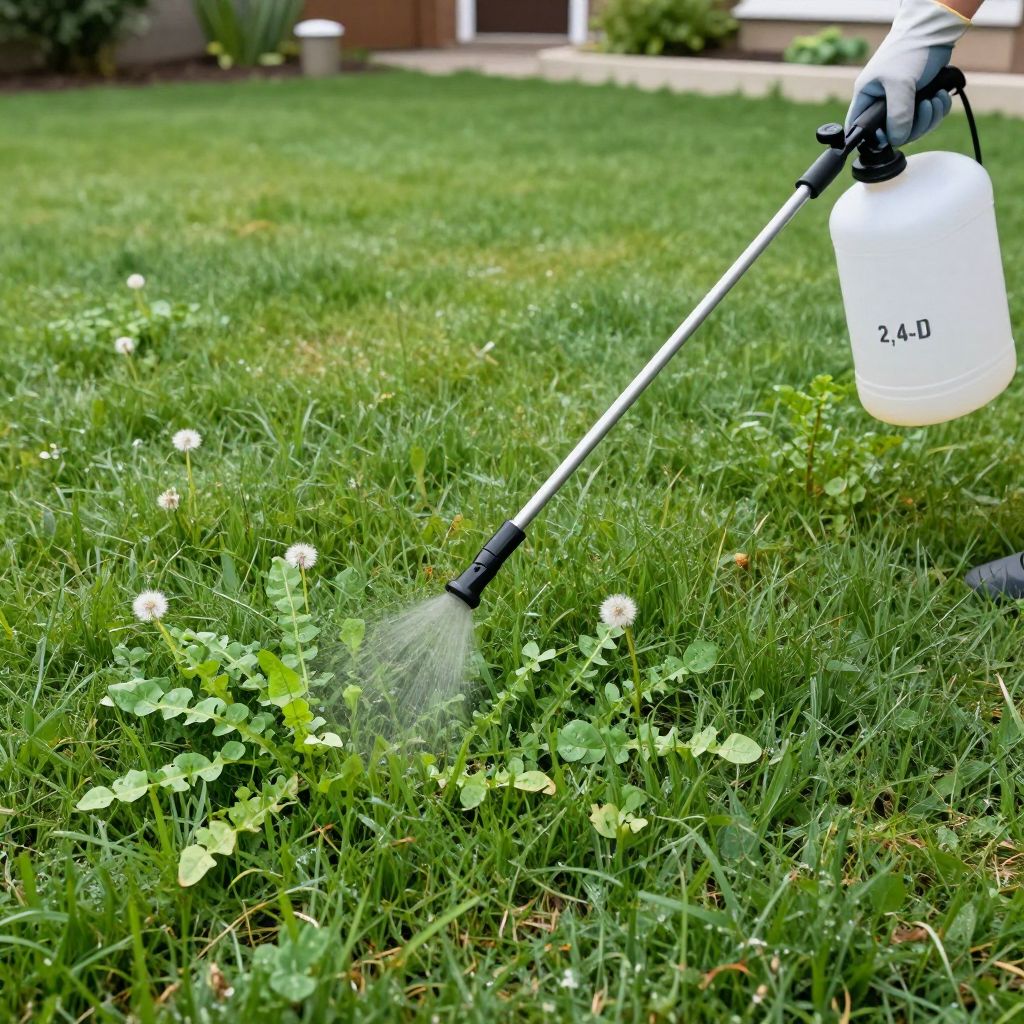
Does 24D kill grass? If you’re worried about spraying your lawn, the short answer is yes—2,4-D can damage or kill grass if it’s applied to the wrong type, at the wrong rate, or under stressful conditions. It is commonly used to control broadleaf weeds, not to protect all turf automatically.
The key is knowing what kind of grass you have and how the product is formulated. Used correctly, 2,4-D is often safe for many established lawns; used carelessly, it can scorch, distort, or thin turf and leave bare patches behind.
Does 24D Kill Grass?
2,4-D is a selective herbicide that targets broadleaf weeds such as dandelion, clover, and plantain. It usually does not kill healthy, established grass when the label is followed, but it can injure turf if the grass is young, stressed, oversprayed, or naturally sensitive to the product.
How 2,4-D Works in the Lawn
2,4-D is a synthetic auxin herbicide. In simple terms, it disrupts the growth pattern of susceptible plants, causing twisting, curling, and eventual decline in broadleaf weeds.
Grasses often tolerate it better because their growth response is different. That said, tolerance is not the same as immunity, and lawn injury can still happen.
What it is meant to control
- Dandelions
- Clover
- Plantain
- Chickweed
- Other common broadleaf weeds
What it can damage
- Young or newly seeded turf
- Heat-stressed or drought-stressed lawns
- Lawns treated at too high a rate
- Desirable broadleaf ornamentals nearby
When 2,4-D Can Harm Grass
Even turfgrass that is usually tolerant can show injury if conditions are poor. The most common problem is not the chemistry itself, but misuse or timing.
Common situations that increase injury
- New seedings: Young grass has shallow roots and tender growth.
- Heat or drought: Stressed turf absorbs damage more easily.
- Overapplication: Too much product can burn turf or stunt growth.
- Spray drift: Fine droplets can land on sensitive plants and edges of the lawn.
- Wrong formulation: Some products are mixed with other herbicides that are harsher on turf.
If your lawn has thin spots, disease, compaction, or poor drainage, it will be less forgiving. A healthy, actively growing lawn is much more likely to recover from minor exposure than a weak one.
Which Grasses Are Most at Risk?
Not all turf species respond the same way to 2,4-D. Many established cool-season and warm-season lawns tolerate it well when used properly, but sensitivity varies by species, age, and weather.
Higher-risk turf situations
- Recently seeded lawns
- New sod that has not rooted in
- Ornamental grasses that are not true turfgrass
- Lawns under stress from mowing too short, compacted soil, or poor irrigation
If you are not sure what grass you have, check whether it is a common lawn species such as Kentucky bluegrass, tall fescue, perennial ryegrass, bermudagrass, zoysia, or St. Augustinegrass. Product labels often list turf species that are safe to treat and species that should be avoided.
Signs 2,4-D Has Injured Grass
Herbicide injury can look like several other lawn problems, so don’t assume every yellow patch is from 2,4-D. Look for patterns and timing after application.
Typical injury symptoms
- Twisted or curled blades
- Distorted new growth
- Yellowing or bronzing
- Uneven thinning in sprayed areas
- Patchy damage near spray overlap or edges
Severe exposure can cause dead patches, but light injury often fades as the grass grows out. If the turf is still alive, recovery depends on watering, mowing, and avoiding more stress.
How to Use 2,4-D Safely on Grass
The safest approach is to treat 2,4-D like any other lawn chemical: read the label first and follow it exactly. The label is the law and the best guide for your specific product and turf type.
- Identify your grass. Make sure the product is labeled for your lawn species.
- Check lawn condition. Do not spray drought-stressed, recently seeded, or newly sodded turf unless the label specifically allows it.
- Choose calm weather. Apply on a low-wind day to reduce drift.
- Measure accurately. Use the label rate, not a guess.
- Protect nearby plants. Keep spray away from flowers, shrubs, vegetables, and trees with exposed roots or tender foliage.
- Water and mow appropriately. Follow label directions for irrigation and mowing before and after treatment.
Practical application tips
- Use a sprayer that delivers an even pattern.
- Do not double-spray overlaps.
- Keep children and pets off the area until the product has dried, or as directed on the label.
- Clean sprayers thoroughly after use to prevent accidental contamination of ornamentals.
Best Lawn Conditions for 2,4-D Use
2,4-D works best when weeds are actively growing and the lawn is healthy enough to recover. That usually means mild weather, adequate moisture, and a turf canopy that is not already under stress.
Good conditions usually include
- Moderate temperatures, not extreme heat
- Active weed growth
- Moist but not saturated soil
- Healthy turf with steady growth
Avoid spraying during hot, dry spells or right before a storm that could wash the product off target. If your soil drains poorly, wait until the lawn is dry enough to avoid compaction and runoff problems.
Recovering Grass After 2,4-D Damage
If you suspect your lawn has been overtreated, the first step is to stop all additional chemical stress. Most mild injury improves with time if the grass is still alive.
What to do right away
- Rinse off visible spray residue only if the label allows and the application was very recent.
- Water the lawn lightly and evenly if the soil is dry.
- Pause mowing until the grass is growing normally again.
- Do not fertilize heavily right away unless the lawn is clearly ready for it.
- Watch for new growth over 1–3 weeks, depending on weather and turf type.
If patches are dead rather than merely discolored, you may need to reseed or patch with sod once the area is stable. Wait until any herbicide residue has broken down enough for reseeding, and always check the product label for reseeding intervals.
Preventing Future Problems
Most 2,4-D lawn problems are preventable. A few careful habits will protect your grass and make weed control more effective.
Good prevention habits
- Mow at the correct height for your turf species.
- Water deeply enough to encourage roots, but avoid soggy soil.
- Reduce compaction by aerating if your lawn is hard and thin.
- Feed the lawn based on soil needs, not a fixed calendar.
- Spot-treat weeds instead of blanket-spraying when possible.
Healthy turf naturally crowds out weeds better than a thin lawn. If your grass is struggling because of shade, poor drainage, or compacted soil, fix those issues first so you need fewer herbicide applications later.
Common Mistakes to Avoid
A few simple errors can turn a useful lawn herbicide into a turf problem. These are the ones most likely to cause damage.
- Spraying the wrong grass type: Not every turf species tolerates every formulation.
- Using more than the label rate: More is not better and can injure grass.
- Applying to stressed turf: Heat, drought, and disease increase risk.
- Ignoring wind: Drift can damage garden beds and neighboring lawns.
- Treating too soon after seeding: Young grass needs time to establish.
Should You Use 2,4-D at All?
For many lawns, 2,4-D is a practical way to control broadleaf weeds without killing established grass. But it is not the only option, and it is not always the best first step.
If your weed problem is small, hand-pulling, improving mowing habits, thickening the turf, and correcting soil issues may be enough. If weeds are widespread, a targeted herbicide can be helpful, but only when you can use it safely and legally for your lawn type.
Conclusion: Protect the Grass While Treating the Weeds
So, does 24D kill grass? Usually not when it is used correctly on established turf, but it can injure or kill grass if the lawn is young, stressed, or treated improperly. Read the label, confirm your grass type, and spray only under suitable conditions.
If you want to improve weed control without harming your lawn, next read up on how to identify common lawn weeds and best practices for mowing and lawn recovery.