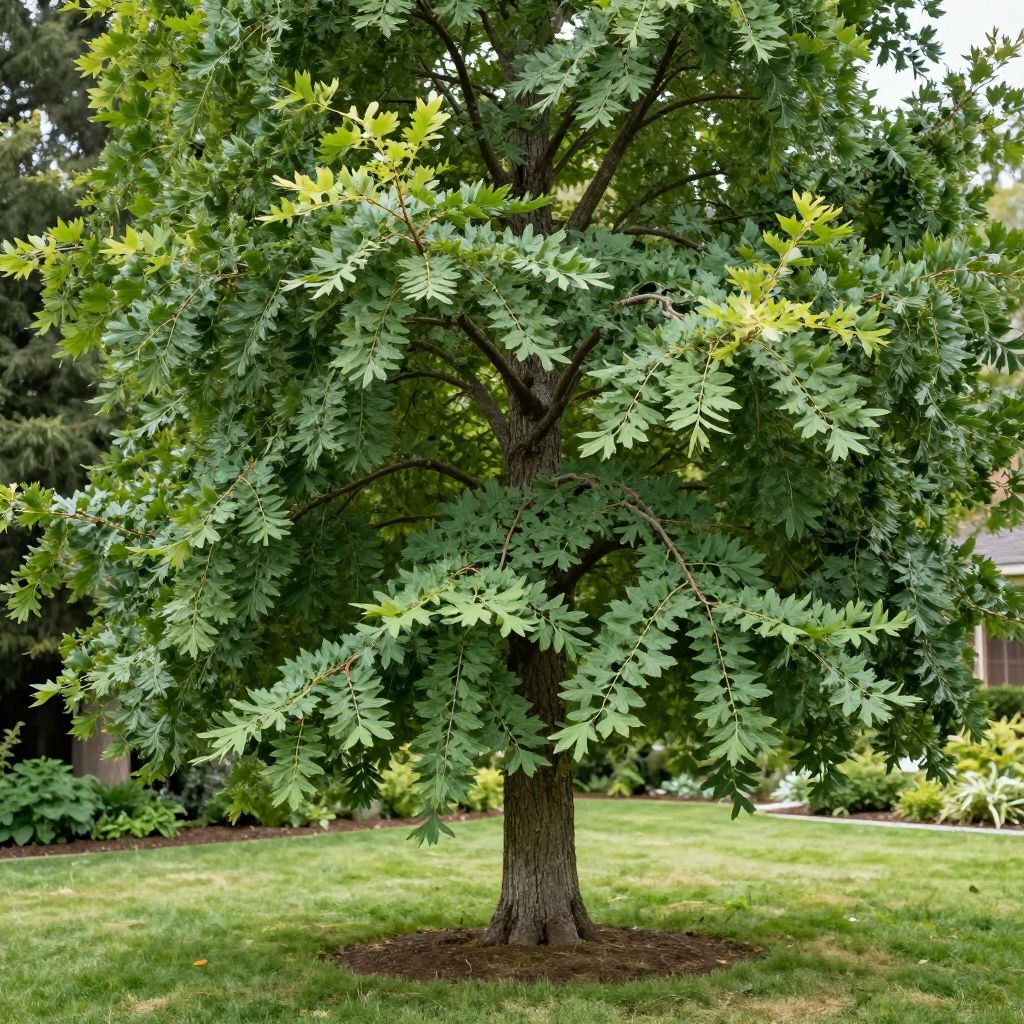
If you’re asking, “What does an elm tree look like?” the answer depends a little on the species, but most elms share a few easy-to-spot features: a vase-shaped canopy, serrated oval leaves, and rough, furrowed bark as they mature. Elms are classic landscape trees, but they can be confused with other shade trees if you only look at one feature.
This guide will help you identify an elm tree in the garden, understand how it grows, and avoid common look-alikes. You’ll also learn what conditions elms prefer if you’re planning to plant one or care for an existing tree.
What does an elm tree look like?
An elm tree is usually a medium to large deciduous tree with a broad, often vase-shaped crown, arching branches, and simple oval leaves with clearly toothed edges. Mature bark is typically gray-brown and deeply ridged, and many elms have leaves that are uneven at the base, which is a useful identification clue.
Key elm tree identification features
1. The overall shape
One of the easiest elm traits to notice is the silhouette. Many elms form a vase-like shape, with branches rising upward and then arching outward, especially on younger trees.
As trees age, the canopy may become broader and more rounded, but the branching pattern often still feels graceful and spreading rather than stiff or columnar.
2. The leaves
Elm leaves are usually:
- Simple, not divided into leaflets
- Oval to elliptical
- Finely to coarsely toothed along the edges
- Often pointed at the tip
- Frequently uneven or lopsided at the base
That uneven leaf base is a classic elm clue. The leaves are typically arranged alternately along the twig, not directly opposite each other.
3. The bark
Young elm bark is usually smoother and grayish. As the tree matures, the bark becomes rougher, darker, and deeply furrowed with ridges and narrow plates.
On older trees, bark texture can be very distinctive, but it varies by species and age. Don’t rely on bark alone, especially if you are identifying a young elm.
4. The twigs and buds
Elm twigs are often slender and may have a zigzag look. The buds are generally small and pointed, and they sit alternately along the twig.
If you’re trying to identify a tree in winter, twig arrangement and bud shape can help, but they’re best used together with bark and branching form.
5. The flowers and seeds
Elms flower early in spring, often before the leaves are fully out. The flowers are small and not showy. They produce flat, papery seeds called samaras, which are often round or oval and may appear in clusters.
These seed structures are another useful clue, especially when the tree is in leaf-out season.
Common elm species and what they look like
American elm (Ulmus americana)
American elm is the classic large shade tree many people picture. It usually has a tall trunk, broad vase-shaped crown, and arching branches that create a cathedral-like form.
It is often planted in parks and large landscapes because of its elegant shape and dense summer shade.
English elm (Ulmus procera)
English elm also has a strong vase shape, but it is less common in many areas. It tends to look stately and upright when young, then broadens with age.
Siberian elm (Ulmus pumila)
Siberian elm is usually smaller and more irregular than American elm. Its leaves are often smaller, and the tree can look a bit coarse or uneven in form.
This species can be mistaken for other elms, but its overall habit is often less graceful than the classic vase-shaped elm silhouette.
Slippery elm (Ulmus rubra)
Slippery elm has rougher, redder inner bark and leaves that are often larger and sandier in texture. It is a native North American elm with a more rugged look.
How to tell an elm from similar trees
Many gardeners confuse elms with other shade trees, especially when trees are young or partially pruned. Use several traits together instead of one clue.
- Versus maple: Maple leaves are usually lobed and often opposite on the twig, while elm leaves are oval, toothed, and alternate.
- Versus ash: Ash leaves are compound, made of several leaflets, while elm leaves are single leaves.
- Versus hackberry: Hackberry leaves can look similar, but the bark and leaf texture differ, and hackberry often has corky bark warts.
- Versus beech: Beech leaves have smoother edges and smoother bark, while elm leaves are toothed and bark becomes deeply ridged with age.
If you are unsure, look at the leaf base, leaf arrangement, branching structure, and bark together. That combination usually gives a much better answer than any single feature.
Growing conditions elms prefer
If you want to plant an elm, choose a site that suits a large, long-lived shade tree. Most elms perform best in full sun and in soil that drains well but still holds some moisture.
Sunlight
Elms generally grow best in full sun. They can tolerate light shade, but a sunny site usually gives stronger growth and a better canopy shape.
Soil
Elms are adaptable, which is one reason they’ve been popular landscape trees. They can handle a range of soils, but they generally do best in deep, moderately fertile soil with good drainage.
If your soil is heavy clay, improve the planting area with compost and make sure water does not sit around the roots. If your soil is sandy, organic matter helps it hold moisture longer.
Moisture
Many elms tolerate periodic wetness better than some other trees, but they should not be planted where water stands for long periods. Young trees especially need steady moisture while they establish.
Space
Plan ahead. Elms become large trees, so give them room for the canopy and roots. Avoid planting too close to buildings, driveways, or overhead wires unless you are working with a smaller species or a professionally selected cultivar.
Planting and early care
When planting an elm, focus on root health and good establishment rather than quick top growth. A young tree that settles in well will usually outperform one that is rushed into poor conditions.
- Choose a site with full sun and enough room for mature spread.
- Dig a hole as deep as the root ball and about 2 to 3 times as wide.
- Set the tree so the root flare sits at or slightly above soil level.
- Backfill with the native soil you removed, breaking up large clods.
- Water thoroughly to settle the soil around the roots.
- Mulch with 2 to 4 inches of organic mulch, keeping it away from the trunk.
Do not bury the trunk flare. One of the most common planting mistakes is setting a tree too deep, which can stress roots and invite decline over time.
Watering young elms
Newly planted elms need regular watering during establishment, especially in warm or windy weather. Rather than following a fixed schedule, check the soil a few inches down and water when it begins to dry.
Deep, infrequent watering is usually better than frequent shallow watering. That encourages roots to grow outward and downward.
Mulching
Mulch helps conserve moisture, reduce weeds, and moderate soil temperature. Keep mulch in a broad ring around the tree, but leave several inches of space around the trunk.
Pruning and maintenance
Elms usually need only light structural pruning when young and occasional cleanup as they mature. Good pruning helps maintain strong branch structure and can reduce future problems.
When to prune
Prune during the dormant season or when the tree is not actively pushing tender new growth, unless you are removing broken, dead, or hazardous limbs. Local disease pressure and climate may affect the best timing, so check what is appropriate in your area.
What to remove
- Dead, damaged, or crossing branches
- Competing leaders on young trees
- Weak branch unions
- Low limbs that interfere with walkways or mowing
Use clean, sharp tools and make cuts just outside the branch collar. Avoid heavy topping, which weakens the tree and can create a messy, unstable canopy.
Pests and diseases to watch for
Elms are tough trees, but they are not trouble-free. The most serious concern in many regions is Dutch elm disease, a fungal disease spread by bark beetles and through root connections between trees.
Signs of trouble
- Sudden wilting or yellowing of leaves on one branch or section
- Leaves that brown and drop early
- Dieback in the canopy
- Noticeable decline in vigor over a short period
Other potential problems include elm leaf beetles, aphids, scale insects, and leaf spot diseases. Many of these are more cosmetic than fatal, but repeated stress can weaken a tree.
How to reduce risk
- Plant disease-resistant cultivars when appropriate for your region
- Keep the tree vigorous with proper watering and mulching
- Prune out dead wood promptly
- Dispose of infected wood according to local guidance
- Avoid injuring the trunk or roots
If you suspect Dutch elm disease or another serious vascular problem, contact a local arborist or extension service quickly. Early diagnosis matters.
Can you propagate an elm tree?
Elms can be propagated from seed, cuttings, or grafting, but home gardeners usually find young nursery trees easier and more reliable. Seed-grown elms may vary from the parent tree, and cuttings can be inconsistent depending on the species.
If you try propagation, collect seed only when it is mature and use fresh material promptly. For most gardeners, planting a healthy young tree is the simplest path.
Landscaping uses for elm trees
Elms are valued for shade, structure, and a classic landscape form. They can work well as specimen trees, street trees, or anchors in large yards where their mature size is welcome.
Because they grow large, elms are best used where their canopy can develop naturally. They are not ideal for tight foundation plantings or small courtyards unless you are working with a carefully selected smaller type.
Common mistakes when identifying or growing elms
- Identifying the tree from bark alone when it is still young
- Confusing alternate elm leaves with opposite maple or ash leaves
- Planting too deep
- Giving too little space for mature spread
- Overpruning or topping the canopy
- Ignoring early signs of disease or decline
Taking a few extra minutes to examine the leaf shape, twig arrangement, and overall habit will save you from misidentifying the tree and make care decisions much easier.
Conclusion
If you want to know what an elm tree looks like, look for a broad, arching, vase-shaped canopy, oval toothed leaves, alternate leaf arrangement, and rough furrowed bark on mature trees. Once you recognize those features together, elm identification becomes much easier.
Next, compare the tree’s leaves and branching pattern with other common shade trees, then check whether your site offers full sun, enough space, and well-drained soil. If you’d like help identifying another tree in your yard, you may also find this guide useful: what type of tree is this?